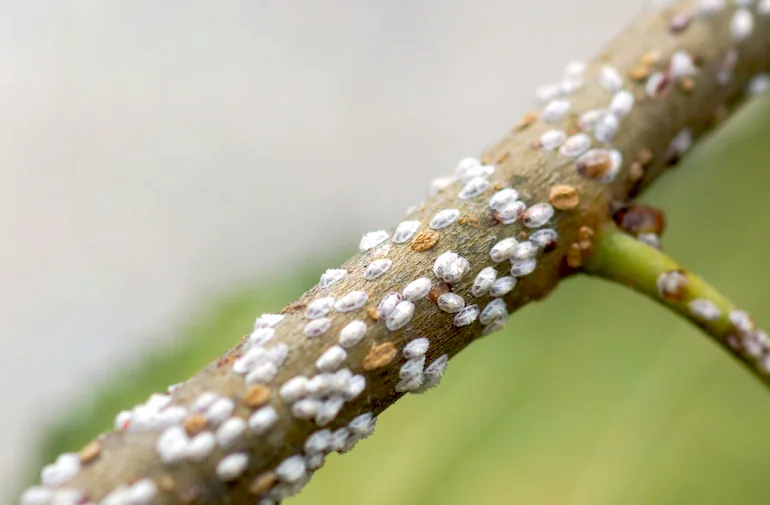
Field Identification
If new growth is curling, yellowing, sticky, or chewed, scale insects may already be on the plant. This pest often builds quietly, then damage appears all at once. Feeding stress weakens growth, reduces yield, and opens the door to secondary disease. Early cleanup is much easier than fighting a full population surge later.
Inspect the newest growth first: leaf undersides, flower buds, stem joints, and tender tips where pests gather. Look for body shape, color, eggs, cast skins, honeydew, webbing, or fresh puncture marks. A hand lens and a white paper tap test help reveal small life stages. Matching visible pests with fresh plant damage confirms active infestation.
Not sure what you have? Use the symptom diagnosis tool →
How to Deal With It
Organic Control Methods
Parasitic wasps in the Encarsia, Aphytis, and Metaphycus genera are the most effective natural controls for scale — they lay eggs inside scale bodies and larvae consume them from inside. These are already present in most outdoor gardens. To support them, plant dill, fennel, sweet alyssum, and flowering herbs nearby. Ladybug larvae (not adults) and lacewing larvae eat soft-bodied scale. Avoid any broad-spectrum spray during scale treatment — it kills the parasitoids that provide long-term control. Ants actively protect scale insects from predators in exchange for honeydew — managing ant access to infested plants dramatically improves biological control effectiveness.
Scale spreads on new plant material — inspect every new plant before bringing it into your garden or greenhouse. Look for raised bumps on stems and leaf midribs, sticky honeydew on leaves below, and sooty mold (black coating) that grows on the honeydew. Scale populations explode on stressed plants — drought stress and over-fertilization with nitrogen both increase susceptibility. Healthy plants in living soil have natural oils and defenses that make them genuinely less attractive reat scale before spring population surge.
Prune heavily infested branches in late winter before new growth starts — remove and bag, do not compost. This dramatically reduces population heading into spring. Ants farming scale must be managed: wrap tree trunks with sticky barriers (Tanglefoot) to prevent ant access, forcing scale populations to face their natural predators without ant protection. This alone often tips the balance toward natural control. Keep plants well-spaced for air circulation — scale thrives in crowded, humid conditions without air movement.
Rubbing alcohol on a cotton swab kills individual scale insects on contact and dissolves the waxy coating that protects them from sprays — effective for light infestations on houseplants or small ornamentals. A soft brush dipped in soapy water scrubs scale off stems. A strong water spray removes crawler-stage scale (the mobile juvenile stage) before they settle and develop their protective coating. Crawlers are the most vulnerable stage — they are active in spring when temperatures warm, tiny, and have no waxy protection yet.
Horticultural oil (dormant oil) smothers overwintering scale by coating their breathing pores — apply in late winter before buds break, coating all bark surfaces thoroughly. This is the single most effective spray timing for scale. During the growing season, neem oil mixed with castile soap penetrates the waxy coating better than soap alone — mix 1 tablespoon neem plus 1 teaspoon soap per quart of warm water, apply every 7-10 days. Target the crawler stage in spring for best results. Rubbing alcohol diluted 1:1 with water sprayed directly on scale kills on contact by dissolving the wax — test on a few leaves first as some plants are sensitive.
Let Nature Handle It
Natural Enemies
- Ladybugs
- Parasitic Wasps
- Lacewings
Threat Map