About
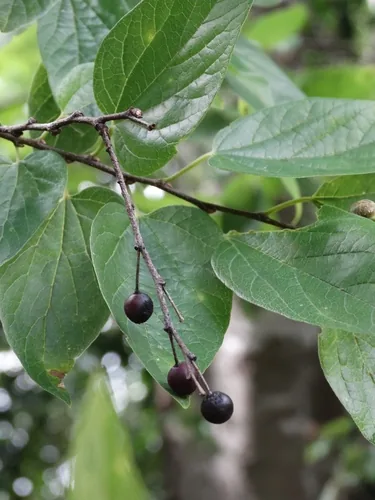
Sugar hackberry (Celtis laevigata) is a medium to large deciduous tree of river bottoms, bottomland woods, and humid subtropical lowlands across the southeastern United States into parts of Mexico and the Caribbean rim where hardy. Mature trees develop light gray, often warty bark and a rounded crown casting dappled shade; small sweet drupes feed migrating songbirds and mammals. It is a workhorse native canopy for windbreaks, riparian buffers, and heat-tolerant urban plantings. Full sun for best form and fruiting; tolerates partial shade as a younger tree in mixed woods. Prefers deep, moist soils but accepts periodic drought once roots are established; handles short inundation typical of floodplain pulses. Tolerates alkaline conditions better than many eastern hardwoods. Sow fresh cleaned seed immediately or cold-moist stratify; germination improves after passing through bird guts in the wild—mimic with scarification tests. Transplant liners in cool wet weather. Air-layering is possible but uncommon; grafting is rare for landscape use. Fruit is thin-fleshed but edible when fully dark; mostly leave for wildlife. Collect fallen twigs for mushroom logs only from healthy trees. Prune for clearance in late winter; avoid heavy summer cuts that stress drought-stressed specimens.
Permaculture Functions
- Wildlife Attractor: Celtis laevigata orange drupes ripen in hungry weeks for migrating songbirds -- while hackberry emperor larvae roll leaves for titmice snacks.
- Erosion Control: Shallow widespread roots armor riparian sand against spring spates -- that strip faster cottonwood regeneration.
- Shade Provider: Light vase-shaped canopy filters Gulf sun for elderberry and beautyberry guilds -- without smothering them.
- Mulcher: Toothed leaves fall early autumn in a thin mat that feeds earthworms without the maple-thick blanket -- that blocks ephemerals.
- Ornamental: Warty gray bark and zig-zag twigs sell native street tree programs -- to cities tired of crepe myrtle repetition.
Companion Planting
- Hackberry nipple gall — cosmetic leaf bumps from insects; usually harmless to tree vigor
- Surface roots — mulch a wide ring instead of mowing tight against the trunk
Threats & Pressure