About
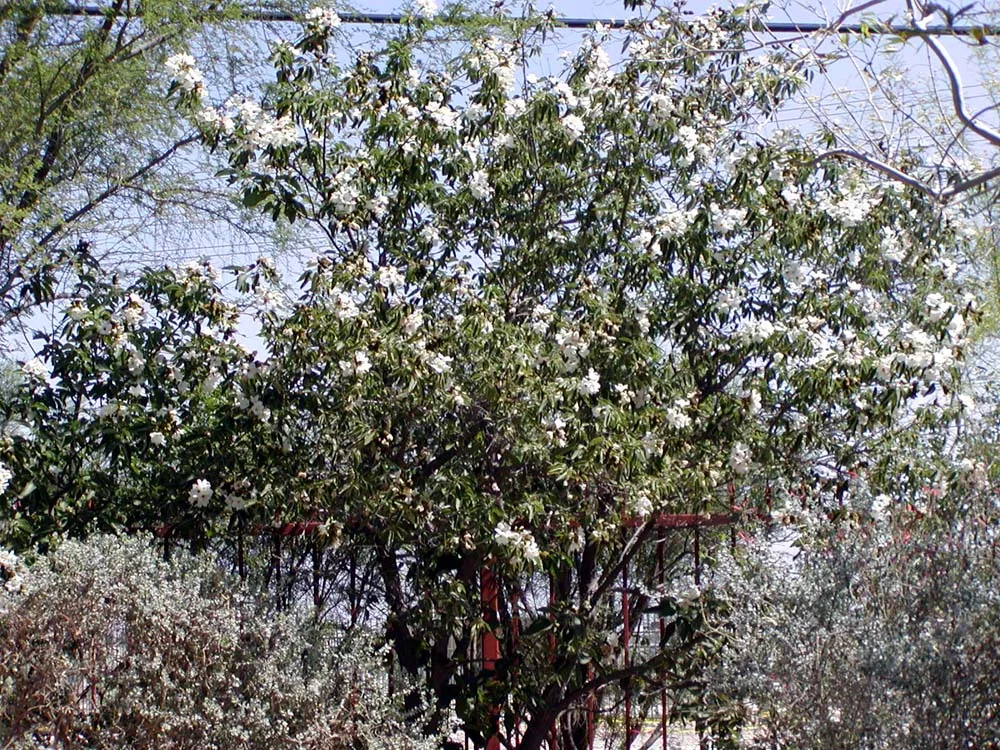
Texas Olive (*Cordia boissieri*), also known as Anacahuita or Mexican Olive, is an evergreen to semi-deciduous shrub or small tree native to southern Texas and northeastern Mexico. It typically reaches heights of 15 to 20 feet (4.5 to 6 meters) with a spread of 10 to 15 feet (3 to 4.5 meters), forming a symmetrical, rounded crown. The tree features large, leathery, ovate leaves measuring 9 to 18 centimeters (3.5 to 7 inches) in length and 5 to 9 centimeters (2 to 3.5 inches) in width, with a velvety texture and silvery undersides. From spring to fall, it produces clusters of showy, trumpet-shaped white flowers with yellow throats, each about 3 to 5 centimeters (1.2 to 2 inches) across, attracting various pollinators. These blooms are followed by olive-like, yellow-green drupes approximately 1.2 to 2.4 centimeters (0.5 to 1 inch) long, which are sweet but mildly toxic when consumed in large quantities. Texas Olive can be propagated by seeds, semi-hardwood cuttings, softwood cuttings, or air layering. Seeds should be collected from mature fruits, cleaned, and sown in well-draining soil. Semi-hardwood or softwood cuttings can be treated with rooting hormone and placed in a suitable growing medium. Air layering involves inducing roots on a stem while still attached to the parent plant before severing and transplanting. This species thrives in full sun, requiring at least 6 to 8 hours of direct sunlight daily for optimal growth and flowering. It prefers well-drained soils and is highly drought-tolerant once established, making it suitable for xeriscaping. Regular watering is beneficial during the establishment phase, but mature plants can withstand extended dry periods. While the fruits are not commonly consumed due to their mildly intoxicating effects when eaten in large quantities, they can be harvested when they turn yellow-green and are fully ripe. Caution is advised if considering consumption, and it's essential to ensure they are prepared safely.
Permaculture Functions
- Ornamental: Cordia boissieri silver-backed leaves flash windward -- while white funnel blooms pump jasmine scent through Rio Grande fence lines.
- Wildlife Attractor: Long-tongued bees and hummingbirds work tubular corollas before olive-shaped drupes feed coyotes and songbirds -- along thornscrub arroyos.
- Erosion Control: Deep roots anchor limestone rubble on south Texas hillsides -- where shallow turf washes into arroyos after monsoon cells.
Companion Planting
Also mentioned as companions:
- Leucophyllum
- Salvia
Not yet profiled in PermiePortal
- None reported
Threats & Pressure