About
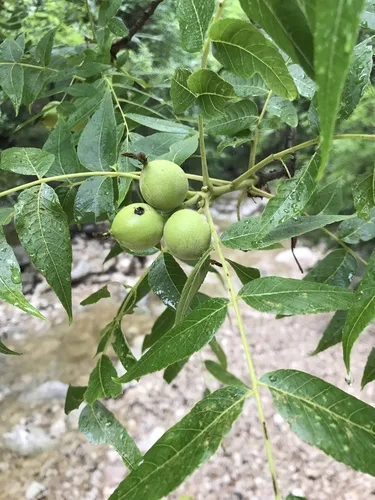
Black walnut (Juglans nigra) is a fast-growing eastern North American tree with tall straight trunks, open branching, and pinnately compound leaves that yield a spicy scent when crushed. It produces round green husks enclosing hard-shelled nuts with rich, oily kernels. Mature trees commonly reach 20 to 30 meters (65 to 100 feet) in open settings and cast deep summer shade. The species is a staple timber and nut tree in temperate agroforestry, but its roots and fallen tissues release juglone, an allelopathic compound that limits many common garden species under and near the canopy. Full sun suits best nut production. Deep, fertile, well-drained loams support rapid growth; trees tolerate occasional drought once established but suffer in persistently wet subsoils. Grow from stratified seed sown after cold treatment, or plant grafted selections for improved nut traits. Taproots make transplanting large specimens difficult; start small and protect from deer browsing. Collect nuts after husks split and begin to yellow; remove husks promptly, wash, and dry kernels slowly to prevent mold. Expect alternate bearing years on seedlings.
Permaculture Functions
- Edible: Kernels are high in oil and protein once freed from thick shells -- use heavy-duty crackers and pick meats for baking where patience exceeds shell volume.
- Wildlife Attractor: Mast feeds squirrels, rodents, and birds; they spread seedlings far beyond planting rows -- plan for volunteer management along fence lines.
- Mulcher: Compound leaves drop early and in large masses -- rake into pathways or chop-and-drop to feed fungal soil food webs under juglone-tolerant understory.
- Windbreaker: Tall crowns and stiff wood reduce wind speeds across fields -- use on north or west edges so shade patterns match sun needs of adjacent beds.
- Dynamic Accumulator: Deep taproots mine calcium and other minerals -- leaf litter recycles those minerals to surface soils where tolerant plants can access them.
Companion Planting
- Tomato
- Potato
- Apple
Threats & Pressure