About
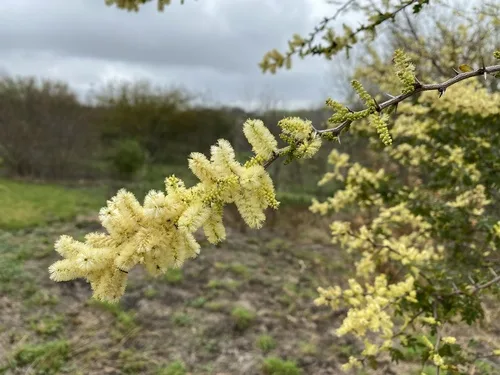
Blackbrush acacia (Vachellia rigidula) is a drought-hardy, thorny shrub of southwestern North American scrub and grasslands, forming dense stands on rocky slopes and calcareous soils. Stems are zig-zagging with paired spines at nodes, and tiny feathery leaves reduce water loss. Creamy spherical flower clusters appear in warm months, maturing to curled pods for wildlife. It suits arid and semi-arid windbreaks, erosion control plantings, and wildlife corridors from interior valleys to northern subtropical edges where hard freezes are brief. Plant in full sun on sharply drained, alkaline-tolerant soils. Established plants survive on rainfall alone in desert climates; irrigate young plants deeply but rarely to encourage deep roots. Scarify seeds or soak in hot water before sowing after soil warms. Transplant container stock during mild weather, protecting from root disturbance because of sensitive taproots. Pods and browse value peak in late warm season; monitor grazing pressure if using for fodder because spines injure mouths unless hayed or processed.
Permaculture Functions
- Nitrogen Fixer: Root nodules house rhizobia suited to dry soils -- fixes atmospheric nitrogen where many legumes fail from drought stress.
- Wildlife Attractor: Flowers feed native bees; pods feed quail and small mammals -- thorny structure also shelters songbirds from raptors.
- Erosion Control: Extensive lateral roots bind rocky slopes -- useful on cuts where irrigation is impossible after establishment.
- Animal Fodder: Leaves and pods are browsed by goats and wildlife when spines are managed -- protein helps dry-season nutrition but requires rotation to avoid mouth injury.
- Border Plant: Dense, thorny walls define grazing exclosures and lane edges -- visually reads as a living fence in rangeland designs.
Companion Planting
Threats & Pressure