About
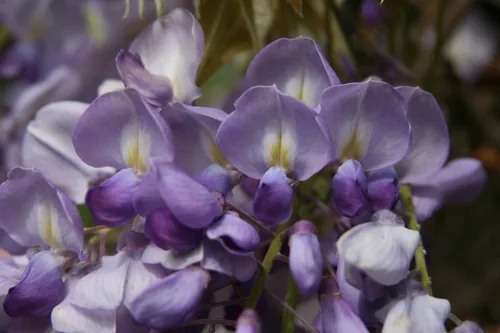
Wisterias are twining leguminous vines famous for long racemes of fragrant pea-flowers and for yanking down shoddy pergolas. **Wisteria frutescens** (American wisteria) is the polite native option for much of the Southeast: slower, less thuggish, still gorgeous. **W. sinensis** and **W. floribunda** are the classic Asian species—stunning, heavy, and invasive in many areas if you let them fruit and seed. Heat is usually not the problem; mismatched chill or poor pruning is. Give a stout arbor, train a single trunk if you want tree-form drama, and do not plant under eaves or power lines unless you enjoy expensive regrets. Full sun for best bloom. Deep, fertile, well-drained soil; consistent moisture while young, somewhat drought-tolerant on big roots. Avoid soggy roots—Phytophthora does not send thank-you notes. Seed (slow, variable, risky for invasiveness on Asian spp.); layering; grafting named cultivars; softwood cuttings under mist. American wisteria from cuttings or reputable native nursery is the permie-bro move. Prune hard after bloom to control weight; seedpods on Asian spp. mean invasive homework—remove before spread.
Permaculture Functions
- Ornamental: Wisteria floribunda foot-long racemes drip perfume -- W. frutescens stays shorter for southern natives; both need steel arbor engineering.
- Nitrogen Fixer: Twining legume roots nodulate -- nutrient bump shows up when prunings rot in place under vines.
- Wildlife Attractor: Bee traffic on grape-scented blooms can overwhelm small arbors -- remove Asian seed pods before riverbanks get new colonies.
- Shade Provider: Mature stems lace overhead to filter noon sun -- girdles naive trees; train on dedicated posts, not saplings you love.
Companion Planting
Also mentioned as companions:
- Grape
- Hardy Kiwi
- Rose
Not yet profiled in PermiePortal
- Weak trellis
- Small fragile trees
Threats & Pressure
- Aphids
- Banded Cucumber Beetle
- Bean Aphid
- Bean Leaf Beetle
- Bean Weevil
- Corn Earworm
- Cowpea Curculio
- Fall Armyworm
- Japanese Beetles
- Kudzu Bug
- Locust Borer
- Locust Leaf Miner
- Lubber Grasshopper
- Pea Moth
- Pea Weevil
- Reniform Nematode
- Root Aphid
- Scale Insects
- Soybean Looper
- Spittlebugs
- Stink Bug
- Striped Cucumber Beetle
- Spotted Cucumber Beetle
- Brown Marmorated Stink Bug
- Harlequin Ladybird
- Velvetbean Caterpillar