About
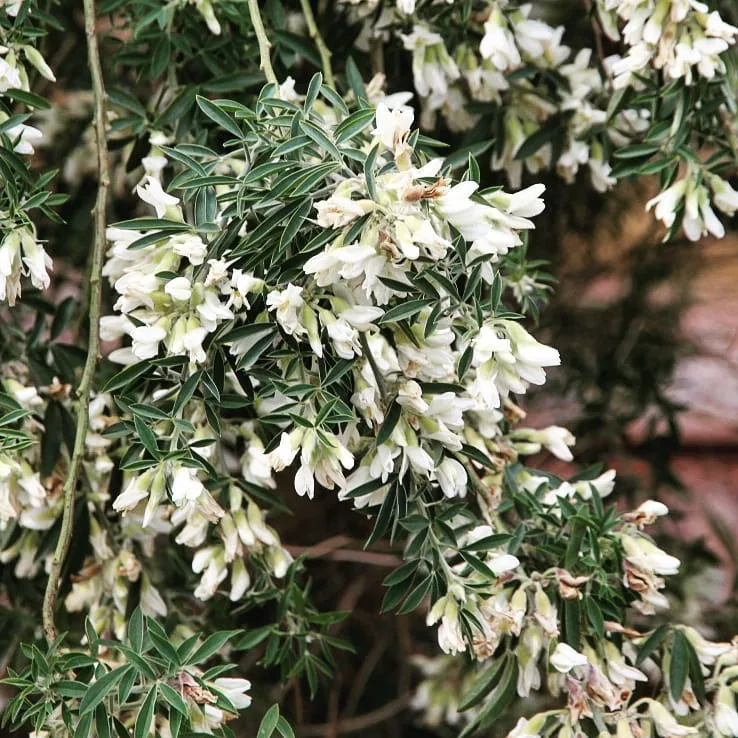
Tagasaste (*Chamaecytisus palmensis*), commonly known as Tree Lucerne, is a fast-growing evergreen shrub or small tree native to the Canary Islands. It typically reaches heights of 3 to 6 meters (10 to 20 feet) and features long, drooping branches with trifoliate, grey-green leaves. The plant produces clusters of small, fragrant, creamy-white pea-like flowers, primarily in spring, though flowering can occur from April to September in some regions. These blooms are followed by narrow seed pods containing hard-coated seeds. Tagasaste is highly valued for its ability to thrive in poor, sandy, well-drained soils and its extensive root system, which can extend down to at least 10 meters, allowing it to access deep soil moisture and nutrients. This deep rooting also contributes to its drought tolerance and effectiveness in soil stabilization. Tagasaste is commonly propagated from seeds. Due to the hard seed coat, seeds should be scarified—either by soaking in hot water or mechanically nicking the coat—to enhance germination. Inoculating seeds with appropriate Rhizobium bacteria ensures effective nitrogen fixation. Seeds are typically sown in winter, from May to August, directly into well-drained soil or in nurseries for later transplantation. Spacing recommendations vary; for fodder production, planting in rows with 2 to 3 meters between plants and 8 to 10 meters between rows is common. Tagasaste thrives in full sun and requires well-drained soils to prevent root diseases. It is highly drought-tolerant once established, owing to its deep root system. However, young plants benefit from regular watering until they are well-established. The plant is adapted to a wide range of temperatures but may experience slowed growth during cooler periods and can withstand light frosts, though young leaves may be susceptible to frost damage. For fodder purposes, tagasaste can be grazed directly by livestock or cut for cut-and-carry systems. It is advisable to allow the plant to establish for 12 to 18 months before the first harvest. Subsequent harvesting or grazing can occur multiple times per year, depending on growth rates and climatic conditions. Regular pruning or grazing helps maintain the plant in a juvenile, vegetative state, which is optimal for fodder quality and prevents flowering that can reduce palatability.
Permaculture Functions
- Nitrogen Fixer: Chamaecytisus palmensis woody legume roots nodulate through dry Canary Island genetics -- chip prunings green so nitrogen hits next avocado row while tissue is still soft.
- Animal Fodder: Protein tests on fresh tagasaste browse hit mid-teens to high twenties percent crude protein -- rotate sheep through height-managed blocks before stems lignify into goat toothpicks.
- Erosion Control: Deep pioneering roots weld volcanic berms on Canary pasture reclamation plots -- where shallow grasses slip off after winter storms.
- Windbreaker: Hedge-height rows blunt trade winds across Atlantic islands -- before fruit trees shoulder the gust behind them.
- Wildlife Attractor: Perfumed white pea-flowers drip nectar for hive bees -- bloom timing aligns with fodder trials where hive density is managed.
- Ornamental: Silvery pinnate leaves plus gold-flowering sprays read Mediterranean formal -- when contained against courtyard walls.
- Pollinator: Perfumed white pea-flowers open in late winter when few other shrubs bloom -- provides critical early nectar for honeybees and native bees during the gap before spring forage.
Companion Planting
Also mentioned as companions:
- Eucalyptus
- Grevillea
Not yet profiled in PermiePortal
- None reported
Threats & Pressure
- Aphids
- Banded Cucumber Beetle
- Bean Aphid
- Bean Leaf Beetle
- Bean Weevil
- Corn Earworm
- Cowpea Curculio
- Fall Armyworm
- Kudzu Bug
- Locust Borer
- Locust Leaf Miner
- Lubber Grasshopper
- Pea Moth
- Pea Weevil
- Reniform Nematode
- Root Aphid
- Scale Insects
- Soybean Looper
- Spittlebugs
- Stink Bug
- Striped Cucumber Beetle
- Spotted Cucumber Beetle
- Brown Marmorated Stink Bug
- Harlequin Ladybird
- Velvetbean Caterpillar