About
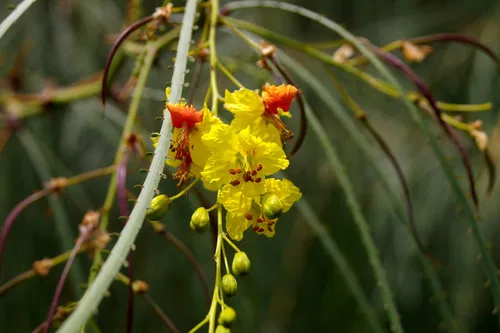
Blue palo verde (Parkinsonia florida) is a Sonoran icon: a small tree with chlorophyll-rich bark that photosynthesizes even when leaves are absent, plus a crown of tiny leaflets that flicker like green lace in wind. Spring brings intense yellow flowers that turn desert roadsides into a pollen rave; mature height is often 15–25 feet with an open, shelterbelt-friendly silhouette. subtropical and tropical Americas: Thrives in Florida’s dry sandy ridges and urban heat islands where drainage is honest; in Puerto Rico use only on well-drained, lean sites—humid clay is how roots file grievances. Full, blazing sun; shade makes it lanky and emotionally needy. Extremely drought-tolerant once established; deep occasional soak beats daily spritzing that trains shallow roots. Scarify seeds and soak overnight; direct-sow warm soil or start in deep pots to respect the taproot’s ambitions. Transplant young trees carefully—taproot sulk is legendary. Best use is ecosystem service: light shade, nectar pulse, and nitrogen facilitation—this is not a timber lottery ticket. Prune for clearance under branches in late dry season when pathogens are less chatty.
Permaculture Functions
- Nitrogen Fixer: Parkinsonia florida roots nodulate with rhizobia that pump plant-available nitrogen into lean desert soils -- interplant creosote-bush companions upslope so both share sparse rainfall without one hogging the water lens.
- Shade Provider: Tiny bipinnate leaves and green photosynthetic bark cast very light shade over young agaves, prickly pears, and human patios -- canopy stays open enough that understory cacti still color instead of etiolating.
- Wildlife Attractor: Spring yellow inflorescences overload native solitary bees; summer pods feed quail and rodents willing to grind hard seeds -- expect litter of spent flowers that dry into golden mulch under the crown.
- Ornamental: Lime-green bark and gold flower clouds sell the tree along roadsides and xeric front yards -- winter silhouette stays airy so designers stop mistaking drought honesty for abandonment.
Companion Planting
Threats & Pressure
- Banded Cucumber Beetle
- Bean Aphid
- Bean Leaf Beetle
- Bean Weevil
- Borers
- Corn Earworm
- Cowpea Curculio
- Fall Armyworm
- Kudzu Bug
- Locust Borer
- Locust Leaf Miner
- Lubber Grasshopper
- Pea Moth
- Pea Weevil
- Reniform Nematode
- Root Aphid
- Scale Insects
- Soybean Looper
- Spittlebugs
- Stink Bug
- Striped Cucumber Beetle
- Spotted Cucumber Beetle
- Brown Marmorated Stink Bug
- Harlequin Ladybird
- Velvetbean Caterpillar