About
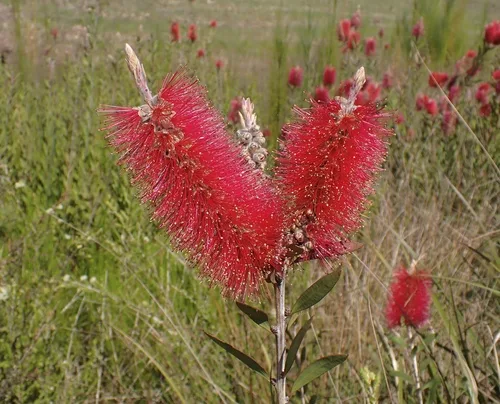
Bottlebrush (Callistemon citrinus) is an evergreen Australian shrub with aromatic leaves and cylindrical crimson flower spikes that read like bottle brushes dipped in paint. It flowers heavily in warm months and again in flushes where winters stay mild, pulling hummingbirds, bees, and butterflies into a predictable nectar schedule. Tough once established, it tolerates heat, sandy soils, and periodic drought—useful on sunny margins, wildlife corridors, and wind-softening rows where irrigation is not a religion. Full sun for dense flowers; shade stretches stems and dulls bloom. Well-drained soil; tolerates lean ground once roots run deep. Young plants need steady moisture; mature plants endure dry spells better than pampered ones. Semi-hardwood cuttings root under humidity in warm seasons. Seeds are fine for species experiments; named forms are cloned. Light pruning after bloom keeps compact habit and renews flowering wood. If harvesting for craft or dye experiments, pick spikes at peak color before brownout. Leave plenty for pollinators—this plant earns its keep in nectar, not just aesthetics. Rake spent flowers if mulch pests become a conversation under the canopy.
Permaculture Functions
- Pollinator: Callistemon citrinus brushes load each stem tip with nectar -- so hummingbirds and carpenter bees work the same spike for days in humid heat.
- Wildlife Attractor: Finches nest in the interior twig mesh -- while paper wasps hunt caterpillars on outer foliage without you spraying every chewed leaf.
- Windbreaker: Multiple shrubs planted on 1.5 m centers knit a porous wall that cuts salt-laden gusts -- along coastal fences while still letting some air through for understory herbs.
- Ornamental: Crimson cylinders against needle-like aromatic leaves read instantly from the sidewalk -- marking drip zones you actually irrigate.
- Erosion Control: Surface roots spread through sandy berms after two wet seasons, locking soil -- where seepage would otherwise undercut mulch.
Field Observations
- No field observations yet
Companion Planting
Threats & Pressure