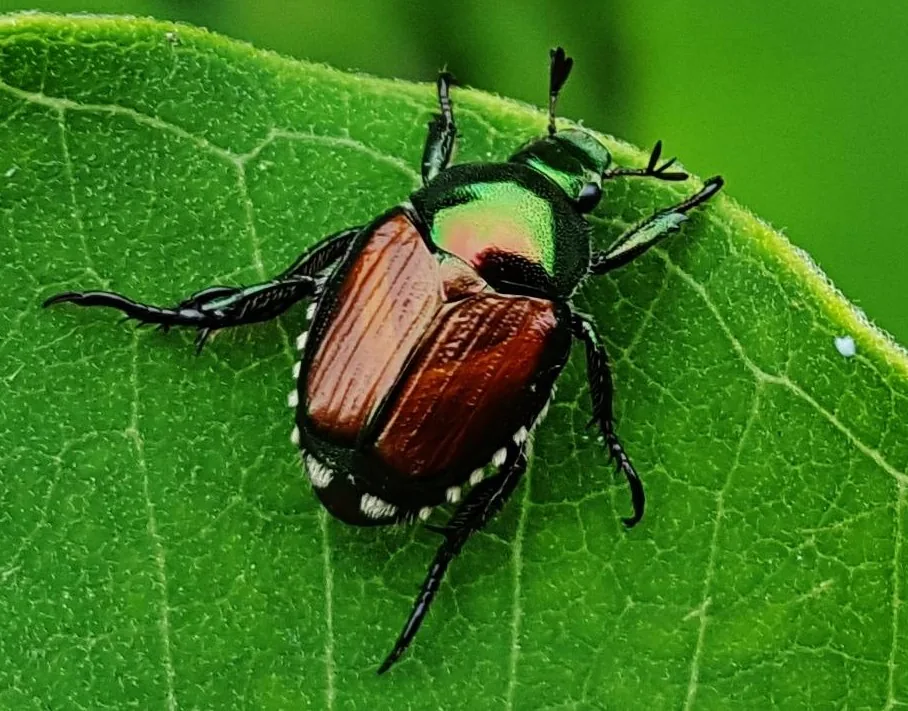
Field Identification
If new growth is curling, yellowing, sticky, or chewed, japanese beetles may already be on the plant. This pest often builds quietly, then damage appears all at once. Feeding stress weakens growth, reduces yield, and opens the door to secondary disease. Early cleanup is much easier than fighting a full population surge later.
Inspect the newest growth first: leaf undersides, flower buds, stem joints, and tender tips where pests gather. Look for body shape, color, eggs, cast skins, honeydew, webbing, or fresh puncture marks. A hand lens and a white paper tap test help reveal small life stages. Matching visible pests with fresh plant damage confirms active infestation.
Not sure what you have? Use the symptom diagnosis tool →
How to Deal With It
Organic Control Methods
Beneficial nematodes (Heterorhabditis bacteriophora) applied to moist lawn soil in late summer target Japanese beetle grubs before they become adults — this is the most effective long-term biological control available. Apply when soil is above 65F (18C) and keep moist for 2 weeks. Milky spore (Bacillus popilliae) is a soil bacteria that builds up over 2-3 years and provides decade-long grub control in lawns — it is a slow investment that pays off. Birds — starlings, robins, grackles — actively dig for grubs; let them work. Do NOT use Japanese beetle pheromone traps unless placed far from your garden — they attract more beetles than they catch and increase damage to nearby plants.
Japanese beetles skeletonize leaves by eating tissue between the veins, leaving a lacy brown shell. They aggregate — one beetle releases pheromones that attract more. A small cluster ignored for 2 days becomes dozens. Act immediately when you see the first beetles rather than waiting for numbers to build. Grubs live in lawns over winter — heavily turfed properties near your garden are beetle nurseries. Reducing lawn area and replacing with ground covers and mulch reduces local grub populations over time.
Hand-picking in early morning is the most effective garden-scale control — beetles are sluggish when cool and drop into a bucket of soapy water easily. Check plants daily during peak season (June-August). Row covers over vulnerable plants during peak adult flight protect plants completely. Interplant with catnip, chives, garlic, and rue which Japanese beetles actively avoid. Geraniums are a documented trap crop — beetles eat them, become temporarily paralyzed, and are easier to collect and destroy.
Shake plants in early morning over a sheet or into soapy water — beetles drop when disturbed and cannot fly well in cool temperatures. This is faster than hand-picking and works well for shrubs and small trees. For row crops, floating row covers installed before adult emergence exclude beetles entirely. Remove covers during flowering for pollination. Yellow and white flowers attract more beetles — consider this when guild planting near vulnerable crops.
Neem oil disrupts Japanese beetle feeding and egg-laying behavior — spray every 7 days during peak season, coating leaf surfaces thoroughly. It will not kill adults already present but deters new arrivals and reduces egg-laying in treated soil. Pyrethrin provides quick knockdown of adults but degrades in hours and harms all insects — use only at dusk as an emergency measure for overwhelming infestations, never near open flowers. Kaolin clay on leaves deters feeding and is safe for beneficials — apply every 7 days and after rain.
Let Nature Handle It
Natural Enemies
- Parasitic Wasps
- Birds
- Beneficial Nematodes
Threat Map