About
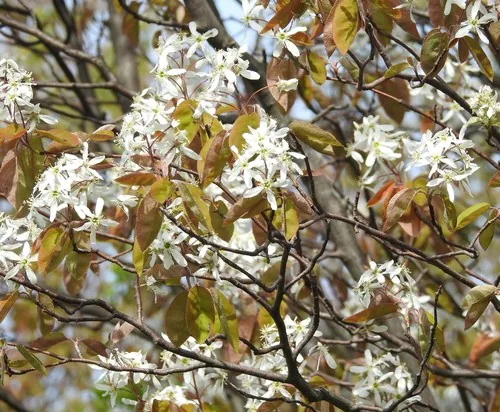
Downy serviceberry (Amelanchier arborea) is a small native tree or multistem shrub of eastern North American wood edges, young forests, and slopes, showing early white flowers and red to purple pome fruit ripening as summer heat builds. Young stems and new leaves are softly hairy—hence downy—while mature height often lands near 15–25 feet (4.5–7.5 m). It is a bridge species between ornamental spring display and quiet edible landscaping for birds and patient humans. Full sun to light woodland edge; more sun improves flowering and fruit set if soil moisture holds. Prefers well-drained, humus-rich soils; tolerates rocky slopes better than stagnant clay pans. Mulch root zones to buffer temperature swings and reduce grass competition. Sow seed after cold stratification; germination can be slow but steady. Softwood cuttings under mist work for clonal selections. Transplant small seedlings in cool moist weather; larger specimens sulk without irrigation support. Pick fruit when fully colored and slightly soft—flavor improves a few days after color change if birds permit. Flowers are short-lived but critical for early pollinators—avoid spraying during bloom. Prune for open vase shape in late winter to reduce twig blight pressure in humid climates.
Permaculture Functions
- Edible: Amelanchier arborea Juneberries sweeten when fully purple-soft -- beat cedar waxwings to the crop or plan a shared quota.
- Wildlife Attractor: Early white racemes feed pollinators -- while ripe pomes feed birds during early summer hunger gaps.
- Ornamental: Downy young stems and delicate spring bloom suit small yards and woodland margins -- matures at 15–25 feet.
- Erosion Control: Fibrous roots stabilize rocky slopes and young-forest transitions -- where soil is thin over stone.
Companion Planting
- Fire Blight and other twig diseases — humid springs on congested growth invite dieback; prune for airflow
- Cedar rust complexes — some regions link rosaceous hosts with alternate hosts; manage strategically
Threats & Pressure
- Aphids
- Apple Maggot
- Bagworm
- Blackberry Psyllid
- Cherry Fruit Fly
- Codling Moth
- Cyclamen Mite
- Fall Webworm
- Japanese Beetles
- Lesser Peachtree Borer
- Oriental Fruit Fly
- Oriental Fruit Moth
- Peach Twig Borer
- Peachtree Borer
- Pear Psylla
- Plum Curculio
- Raspberry Beetle
- Raspberry Cane Borer
- Rose Slug
- Sparganothis Fruitworm
- Spittlebugs
- Stink Bug
- Strawberry Root Weevil
- Twig Girdlers
- Vine Weevil
- Gall Mite
- Rust Mite
- Spotted Lanternfly
- Brown Marmorated Stink Bug
- Eastern Tent Caterpillar
- Harlequin Ladybird
- Tent Caterpillar