About
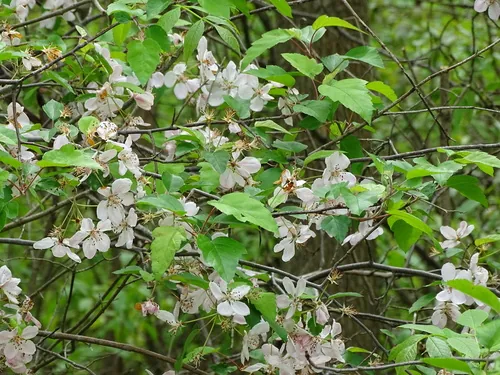
Sweet crabapple (Malus coronaria) is a native North American tree of moist woods and edges, bearing fragrant white to pink spring flowers and yellow to green crabapples that can be sweeter than many wild crabs when fully ripe. Heights of 20–30 feet (6–9 m) are typical, with a broad crown and occasional thorns on wild forms. It is a pollinizer and wildlife tree for hedgerows where cedar-apple rust is managed. Full sun to partial shade; best fruiting with strong light. Moist, well-drained, humus-rich soils suit it; tolerates periodic wet feet better than desert species. Mulch to reduce grass competition. Sow stratified seed; graft selections for predictable landscape traits. Prune for open vase shape to reduce disease pressure. Pick fruit when fully colored and aromatic—quality varies by genotype. Process into sauces and jellies; leave some for wildlife. Bloom follows last hard frosts near 24°F (-4°C) in northern climates.
Permaculture Functions
- Edible: Malus coronaria yellow-green crabs mellow toward rose-scented jelly once kitchen sugar meets their acid backbone -- on humid Appalachian ridges.
- Wildlife Attractor: Pale apple blossoms bridge mason bees between redbud and peach weeks -- while marble fruit fuels waxwings before snowfall.
- Pollinator: Heavy nectar perfume pulls syrphids into foggy April mornings -- when natives still hesitate to open.
- Ornamental: Horizontal limbs studded with fragrant blooms justify courtyard specimens even -- when fruit stays bird-first.
Companion Planting
- Fire Blight — prune strikes in dry weather; sanitize tools
- Cedar-apple rust — separate from alternate juniper hosts when disease pressure is high
Threats & Pressure
- Apple Maggot
- Bagworm
- Blackberry Psyllid
- Cherry Fruit Fly
- Codling Moth
- Cyclamen Mite
- Fall Webworm
- Japanese Beetles
- Lesser Peachtree Borer
- Oriental Fruit Fly
- Oriental Fruit Moth
- Peach Twig Borer
- Peachtree Borer
- Pear Psylla
- Plum Curculio
- Raspberry Beetle
- Raspberry Cane Borer
- Rose Slug
- Sparganothis Fruitworm
- Spittlebugs
- Stink Bug
- Strawberry Root Weevil
- Twig Girdlers
- Vine Weevil
- Gall Mite
- Rust Mite
- Spotted Lanternfly
- Brown Marmorated Stink Bug
- Eastern Tent Caterpillar
- Harlequin Ladybird
- Tent Caterpillar