About
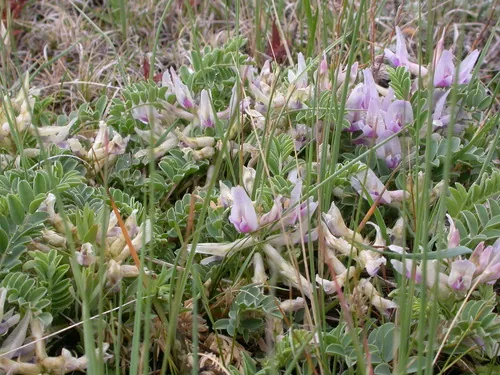
Groundplum milkvetch is a prairie legume with pinnate silvery-green leaves, purple-pea flowers, and inflated pods that bury themselves and swell into plum-like underground fruits. The subterranean "plums" were a known Indigenous food on the Plains; above-ground parts of many Astragalus spp. are not snack material—know your plant. This is a sun-loving Great Plains / tallgrass personality, not a swamp queen. In humid lowland heat it is mostly a curiosity unless you simulate its fast-draining, lean conditions. Full sun; dry to mesic, well-drained soils; drought-tolerant deep taproot once established. Wet feet rot it faster than optimism. Scarified seed in spring; transplant young taprooted seedlings carefully. Slow from seed; patience is not optional. Gather underground plums when pods signal maturity and only with positive ID—never confuse random milkvetches with locoweed-type species.
Permaculture Functions
- Edible: Astragalus crassicarpus buries inflated pods that swell into sweet underground "plums" -- harvest only with confident ID and tribal or scholarly guidance, because other Astragalus species carry toxic alkaloids you do not want to audition.
- Nitrogen Fixer: Prairie legume roots carry rhizobia that fix nitrogen into lean sand -- interplant with little bluestem and coneflower so fixed N cycles when tops die back in fall.
- Wildlife Attractor: Purple banner-and-keel flowers feed native bees in open sun when many turf weeds offer nothing -- leave some pods for ground-foraging wildlife if ethics and law allow.
- Ground Cover: Silvery pinnate leaves form low rosettes that knit sparse ground in dry mimic beds -- it will not tolerate irrigation-heavy lawn culture or heavy clay that suffocates the taproot.
Companion Planting
- Irrigation-heavy lawn culture
- Heavy clay bogs
Threats & Pressure
- Aphids
- Banded Cucumber Beetle
- Bean Aphid
- Bean Leaf Beetle
- Bean Weevil
- Corn Earworm
- Cowpea Curculio
- Fall Armyworm
- Japanese Beetles
- Kudzu Bug
- Locust Borer
- Locust Leaf Miner
- Lubber Grasshopper
- Pea Moth
- Pea Weevil
- Reniform Nematode
- Root Aphid
- Rootknot Nematodes
- Soybean Looper
- Spittlebugs
- Stink Bug
- Striped Cucumber Beetle
- Spotted Cucumber Beetle
- Brown Marmorated Stink Bug
- Harlequin Ladybird
- Velvetbean Caterpillar