About
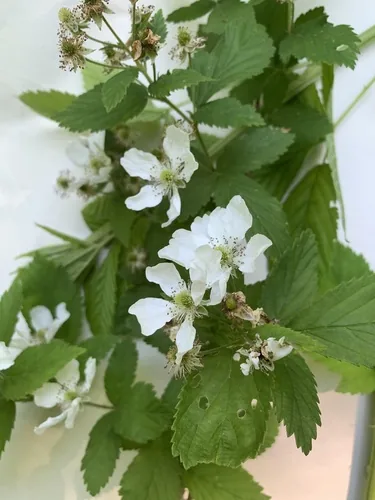
Chickasaw blackberry (Rubus argutus) is a native North American blackberry complex of upright to arching canes armed with fierce sawteeth, producing crops of small to medium black drupes in early to mid summer depending on latitude and heat. Canes commonly reach 4–7 feet (1.2–2.1 m) and spread by tip-rooting, forming impenetrable thickets for wildlife and determined pickers. It suits hedgerows, fencerows, and savanna edges where periodic mowing or fire manages succession. Full sun for heaviest fruiting; tolerates partial shade with fewer berries. Moist, fertile, well-drained soils yield best; tolerates sandy banks if irrigated during fruit fill. Mulch to reduce weed competition around new primocanes. Tip-layer canes in late summer; sever rooted tips in spring. Root cuttings in winter. Purchase virus-indexed nursery stock if building a commercial planting; wild clones vary in flavor and disease. Pick when berries detach easily and shine fully black—morning picks store better in heat. Process or refrigerate within hours; thorn gloves beat bravery. Remove spent floricanes after fruit to reduce disease inoculum.
Permaculture Functions
- Edible: Sawtooth canes yield early-summer black drupelets that are tart straight off the cane and excellent for jam, wine, or syrup -- when sugar balances astringency.
- Wildlife Attractor: Thorny thickets give nesting cover, -- while flowers and fruit feed songbirds, mammals, and diverse pollinators along fencerows.
- Erosion Control: Fibrous roots and interlaced canes lock soil on ditch banks, pasture edges, and old-field transitions -- where tip-rooting spreads.
- Border Plant: Managed hedgerows become a living barrier that slows trespass and contains livestock better -- than smooth wire alone.
Companion Planting
Also mentioned as companions:
- Blackberry Lily
Not yet profiled in PermiePortal
- Thorns — serious puncture hazard; site away from high-traffic pinch points
- Invasive tendency outside native range — verify local ecology before moving clones across regions
Threats & Pressure
- Apple Maggot
- Bagworm
- Blackberry Psyllid
- Cherry Fruit Fly
- Codling Moth
- Cyclamen Mite
- Fall Webworm
- Japanese Beetles
- Lesser Peachtree Borer
- Oriental Fruit Fly
- Oriental Fruit Moth
- Peach Twig Borer
- Peachtree Borer
- Pear Psylla
- Plum Curculio
- Raspberry Beetle
- Raspberry Cane Borer
- Rose Slug
- Sparganothis Fruitworm
- Spittlebugs
- Stink Bug
- Strawberry Root Weevil
- Twig Girdlers
- Vine Weevil
- Gall Mite
- Rust Mite
- Spotted Lanternfly
- Brown Marmorated Stink Bug
- Eastern Tent Caterpillar
- Harlequin Ladybird
- Tent Caterpillar