About
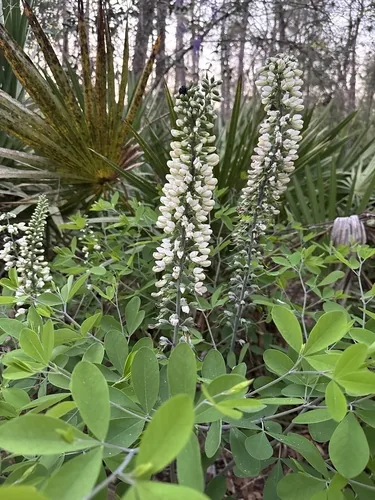
White wild indigo (Baptisia alba) is a long-lived legume perennial of southeastern North American prairies and open woods, with blue-green trifoliate leaves and tall spikes of white pea flowers in late spring. Plants reach 3–4 feet (0.9–1.2 m), forming shrub-like clumps with deep taproots. It fixes nitrogen slowly but steadily—patience beats bagged urea for lean-soil ethics. Full sun for strongest flowering and nodule activity; shade reduces bloom. Well-drained, average to lean soils suit it; wet clay rots crowns. Water deeply during establishment only. Sow scarified seed with cold stratification; division is difficult—prefer fresh seed for large areas. Cut back dead stems in late winter if tidy gardens matter. Leave seed pods for ornamental rattles and bird interest. Peak bloom follows late-spring warmth after frost risk near 28°F (-2°C) declines.
Permaculture Functions
- Nitrogen Fixer: Baptisia alba nodulates on deep taproots -- cut spent stems in place so nodules slough into soil rather than exporting biomass off-site.
- Pollinator: Creamy white papilionaceous spikes peak when long-tongued Bombus queens still forage -- earlier than many prairie composites.
- Ornamental: Glaucous trifoliate mounds read like small shrubs before bloom -- white candles rise from blue-green cushions in lean sun.
- Erosion Control: Taproot anchors dry prairie banks -- tolerates droughty sand where Baptisia australis wants more moisture.
Companion Planting
- Transplanting large clumps—taproot sulk is legendary
- Overwatering + heavy soil — crown rot invites replacement shopping
Threats & Pressure
- Aphids
- Banded Cucumber Beetle
- Bean Aphid
- Bean Leaf Beetle
- Bean Weevil
- Corn Earworm
- Cowpea Curculio
- Fall Armyworm
- Japanese Beetles
- Kudzu Bug
- Locust Borer
- Locust Leaf Miner
- Lubber Grasshopper
- Pea Moth
- Pea Weevil
- Reniform Nematode
- Root Aphid
- Soybean Looper
- Spider Mites
- Spittlebugs
- Stink Bug
- Striped Cucumber Beetle
- Spotted Cucumber Beetle
- Brown Marmorated Stink Bug
- Harlequin Ladybird
- Velvetbean Caterpillar