About
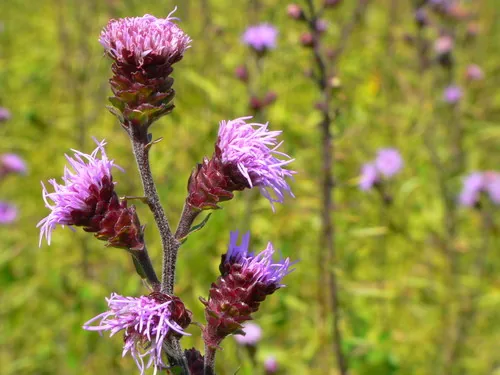
Eastern blazingstar (Liatris scariosa) is a prairie and savanna perennial bearing rounded heads of rosy-purple florets along stout stems, blooming in mid to late summer when many meadows need vertical punctuation. Plants often reach 2–5 feet (0.6–1.5 m) from a taproot and corm-like base, with narrow leaves that can clasp the stem. It suits dry-mesic borders, oak openings, and pollinator strips across eastern and central North American climates. Full sun for strong stems; partial sun works only where heat and moisture are balanced. Prefers well-drained soils; tolerates drought after establishment better than heavy irrigation on clay. Avoid low frost pockets that collect cold, still air on marginally hardy sites. Sow seed with winter stratification; seedlings take a few years to bulk before heavy bloom. Divide carefully in early spring—thick roots resent rough handling. Avoid deep cultivation around established clumps; dormant crowns are easy to damage. Leave most spikes for pollinators; cut a few for dried arrangements at peak color. Seed heads feed finches if cleanup waits until late winter. Mark planting locations in fall to avoid spring shovel accidents.
Permaculture Functions
- Pollinator: Liatris scariosa rounded rose-purple heads bloom mid to late summer -- for bees and butterflies in dry-mesic prairies.
- Wildlife Attractor: Seed heads feed finches -- standing stems shelter overwintering beneficial insects if left uncut.
- Ornamental: Button-shaped inflorescences differ from spike-type blazingstars -- adds design contrast in savanna mixes.
- Erosion Control: Taprooted clumps stabilize sunny slopes when planted in groups -- on well-drained soil.
Companion Planting
- Wet winter soils on heavy clay — root rot on dormant plants without slope or drainage work
- Overfertilization — lodging and reduced flowering on lush, naive growth
Threats & Pressure