About
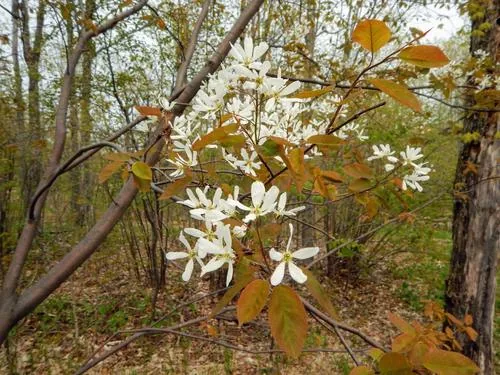
Allegheny serviceberry (Amelanchier laevis) is a multi-stemmed deciduous small tree or large shrub native to eastern North American wood edges and slopes, valued for early white flowers, edible purple-black berries, and orange-red fall color. Mature plants often reach 15–25 feet (4.5–7.5 m) with smooth gray bark and finely toothed leaves; fruit ripens before many other berries, filling the hunger gap for people and wildlife. In food forests and riparian buffers it layers nicely between taller canopy and herbaceous ground without pretending to be a heavy crop tree. Part sun to full sun gives the heaviest flowering and fruit; tolerates light shade with thinner crops. Prefers moist, well-drained, humus-rich soil but accepts average garden conditions once established. Mulch the root zone to reduce drought stress during dry spells; avoid constantly soggy sites that favor root rots on stressed transplants. Sow cleaned seed after cold stratification (roughly 90–120 days near 34–40°F (1–4°C)) or fall-sow outdoors for natural stratification. Softwood cuttings in early summer under humidity can root on vigorous stock. Transplant young seedlings in cool, cloudy weather; bare-root specimens need attentive watering the first growing season. Pick berries when fully colored, soft, and sweet—often early in the local berry calendar. Use fresh, cooked, or dried quickly; they do not store like supermarket fruit. Prune for openness after fruiting if branches crowd or rub, improving airflow without butcher cuts.
Permaculture Functions
- Edible: Amelanchier laevis berries ripen purple-black and soft before most bramble crops, giving early pies and syrups with almond aftertones -- they ferment fast in warm kitchens, so process within a day of picking.
- Wildlife Attractor: White spring cymes feed bees during the hunger gap before canopy bloom while Juneberries feed catbirds and robins weeks later -- leave a windfall strip if you want honest bird traffic.
- Erosion Control: Shallow fibrous roots stabilize rain-garden berms and woodland-path cuts where intermittent moisture would kill drought specialists -- mulch young transplants until the mat knits.
- Ornamental: Smooth gray bark, fine branching, and orange-red fall color carry ornamental weight in edible hedgerows -- no separate show-plant budget required.
- Mulcher: Thin leaves drop early autumn minerals onto blueberry and hazelnut guilds below -- rake only where mats threaten spring bulbs, not obsessively across entire slopes.
Companion Planting
- Black Walnut — juglone-sensitive plants may struggle under heavy walnut drip lines
- Fire Blight — rosaceous relatives can share bacterial blossom blight during warm wet bloom
Threats & Pressure
- Apple Maggot
- Bagworm
- Blackberry Psyllid
- Borers
- Cherry Fruit Fly
- Codling Moth
- Cyclamen Mite
- Fall Webworm
- Japanese Beetles
- Lesser Peachtree Borer
- Oriental Fruit Fly
- Oriental Fruit Moth
- Peach Twig Borer
- Peachtree Borer
- Pear Psylla
- Plum Curculio
- Raspberry Beetle
- Raspberry Cane Borer
- Rose Slug
- Sparganothis Fruitworm
- Spittlebugs
- Stink Bug
- Strawberry Root Weevil
- Twig Girdlers
- Vine Weevil
- Gall Mite
- Rust Mite
- Spotted Lanternfly
- Brown Marmorated Stink Bug
- Eastern Tent Caterpillar
- Harlequin Ladybird
- Tent Caterpillar