About
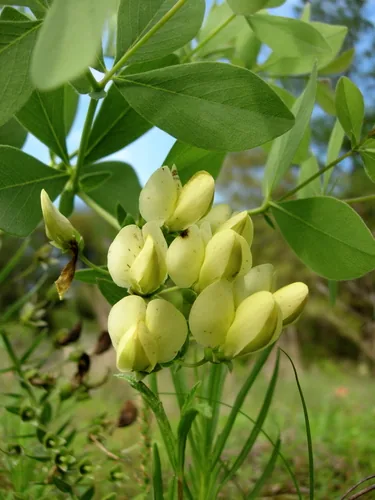
Plains wild indigo (Baptisia bracteata) is a mounding legume perennial of central North American prairies and open woods, bearing cream to pale yellow pea flowers in late spring and blue-green trifoliate leaves on bushy plants about 1–2 feet (30–60 cm) tall, often wider than high. Deep taproots and rhizobia partnerships build soil under sunny borders without demanding irrigation. It suits meadow strips, gravel gardens, and any design tired of thirsty foundation shrubs. Full sun for strongest bloom and nitrogen fixation; plants lean and flop in shade. Well-drained, average to lean soils mimic prairie truth; wet clay rots crowns. Drought-tolerant once established; water deeply only during prolonged dry heat in the first year. Sow scarified seed after cold-moist stratification for uniform germination. Divide carefully in early spring—large roots resent casual shovel violence. Avoid moving mature plants unless necessary; first-year sulking is normal. Leave seed pods for ornamental rattles and bird interest, or collect ripe seed for restoration mixes. Cut back dead stems in late winter if tidy gardens matter; otherwise leave for insect nesting. Bloom peaks track local late-spring warmth, often after last frosts near 28°F (-2°C).
Permaculture Functions
- Nitrogen Fixer: Baptisia bracteata rhizobia nodulate deep taproots on dry prairies, leaving nitrogen-rich crown tissue when tops die back -- chop-and-drop spent stems in autumn or burn patches on rotation to match local restoration recipes.
- Pollinator: Cream pea banners and keels offer pollen and nectar to queen bumblebees and small solitary bees during short late-spring bloom -- earlier than taller Baptisia australis, so stagger both for extended legume flower service.
- Erosion Control: Woody crown and thick lateral roots anchor gravelly slopes and reconstructed berms where shallow-rooted annuals wash -- tolerates drought once established; wet clay rots the crown honest and fast.
- Ornamental: Silvery-blue trifoliate mounds read as living boulders in gravel gardens before inflorescences spike -- pairs visually with little bluestem without competing for identical root depth if spaced generously.
Companion Planting
- Transplant shock — large taproots sulk; direct-seed or move young plants only
- Overwatering + heavy soil — crown rot invites replacement shopping
Threats & Pressure
- Aphids
- Banded Cucumber Beetle
- Bean Aphid
- Bean Leaf Beetle
- Bean Weevil
- Corn Earworm
- Cowpea Curculio
- Fall Armyworm
- Japanese Beetles
- Kudzu Bug
- Locust Borer
- Locust Leaf Miner
- Lubber Grasshopper
- Pea Moth
- Pea Weevil
- Reniform Nematode
- Root Aphid
- Soybean Looper
- Spider Mites
- Spittlebugs
- Stink Bug
- Striped Cucumber Beetle
- Spotted Cucumber Beetle
- Brown Marmorated Stink Bug
- Harlequin Ladybird
- Velvetbean Caterpillar