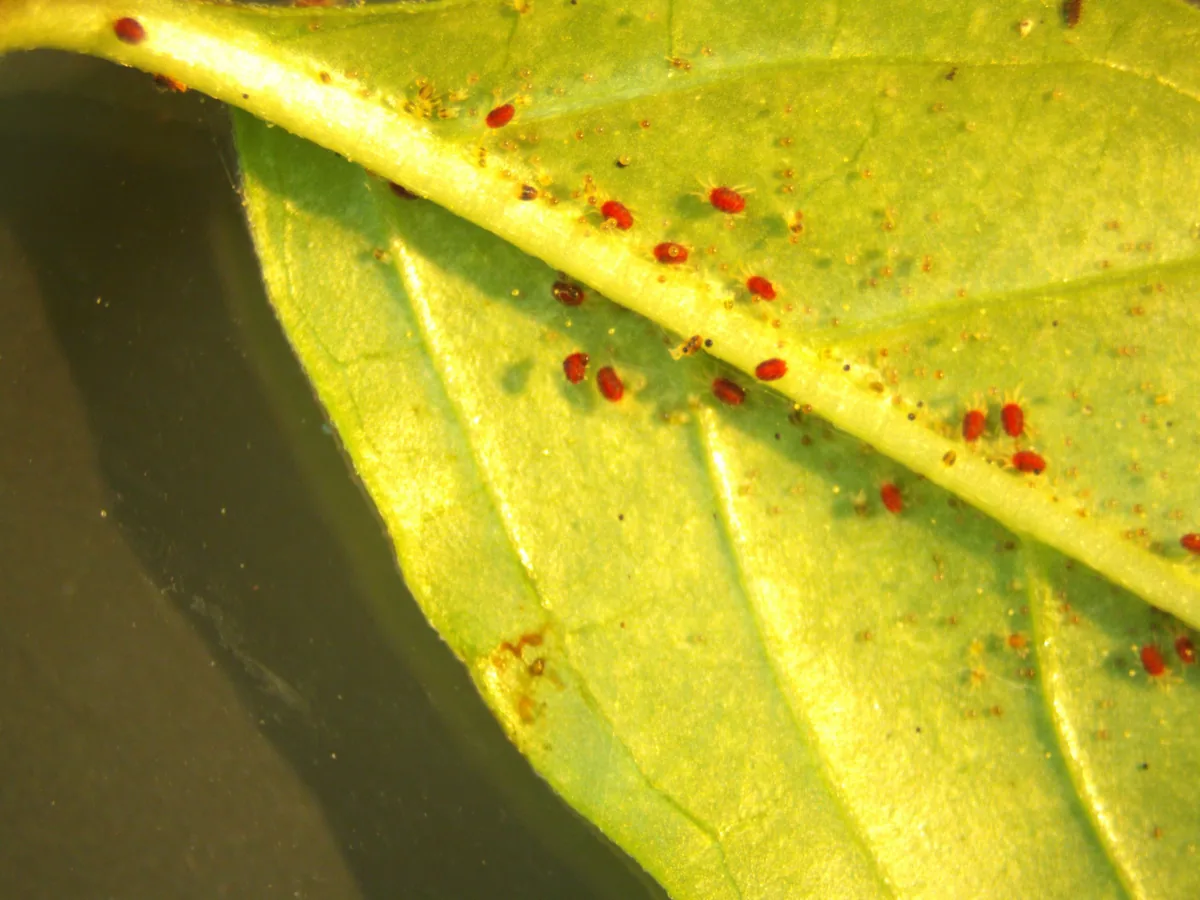
Field Identification
If leaves look dusty, speckled, bronzed, or curled without obvious chewing, spider mites is a likely suspect. Mites are tiny but can multiply fast, especially during heat and dry air. Plants lose vigor as feeding drains cell contents from leaves and tender growth. Early action matters, because heavy infestations can spread through a bed in days.
Use a hand lens and check leaf undersides first, especially near veins and new growth. Look for pinprick stippling, fine webbing in some species, and tiny moving dots that range from pale to red or brown. Tap a leaf over white paper; moving specks suggest active mites. Stippled leaves plus mites or eggs clustered under foliage confirms the diagnosis.
Not sure what you have? Use the symptom diagnosis tool →
How to Deal With It
Organic Control Methods
Predatory mites (Phytoseiulus persimilis or Neoseiulus californicus) are the most effective biological control for spider mites — unlike ladybugs, these can actually be purchased and released successfully because they actively hunt mites on the same leaf surfaces. Order from a reputable insectary and release immediately on arrival, in the evening, directly onto infested leaves. They need humidity above 60% to survive — mist the release area first. Ladybugs and lacewings eat mites too but work too slowly for an active infestation. Long term, plant dill, fennel, and coriander nearby to support predatory mite populations naturally.
Spider mites are a stress indicator — they explode on plants that are hot, dry, and dusty. If you have mites, your plant is probably thirsty. Consistent soil moisture is the single most effective prevention. Mites also hate humidity — a dry indoor environment or a drought-stressed outdoor bed is an invitation. Overhead watering or misting leaves suppresses populations. Dusty leaves are mite habitat — clean leaf surfaces in dry conditions. Avoid broad-spectrum pesticides entirely: they kill the predatory mites that keep spider mites in check, and populations rebound faster and harder after chemical treatment.
Spider mites spread rapidly in hot, dry weather — populations can double every 3-5 days above 80F (27C). Check undersides of leaves weekly during summer heat. Remove and bag heavily infested leaves immediately — do not compost them, mites survive in compost. Interplant with Chinese chives, coriander, and dill which harbor predatory mite populations. Keep beds mulched to retain moisture and reduce the dry hot conditions mites prefer. Avoid monocultures — diverse plantings slow the spread between plants.
A strong jet of water aimed at leaf undersides is the first and most effective mechanical control for spider mites — more so than for most other pests because mites are lightweight and cannot easily reattach. Do it every 2-3 days for 2 weeks to break the egg-to-adult cycle (eggs hatch in 3 days in warm weather). Do it in the morning so leaves dry before evening to avoid fungal issues. For potted plants, take them outside and blast thoroughly including the pot surface where mites shelter. This alone resolves light to moderate infestations if done consistently.
Insecticidal soap is the most reliable spray — mix 1-2 teaspoons castile soap per quart of water and coat leaf undersides thoroughly where mites live. It kills by contact and stops working when dry, so coverage matters more than quantity. Apply every 3 days for 2 weeks to catch newly hatched eggs. Neem oil disrupts mite molting and egg laying — mix 1 tablespoon neem plus 1 teaspoon castile soap per quart of warm water, apply weekly. In hot weather, spray at dusk only — neem and soap applied in direct sun cause leaf burn. Rosemary oil and eucalyptus oil sprays have real repellent effect on mites specifically and are worth adding to the rotation. Skip garlic and hot pepper sprays — limited evidence they work on mites and they irritate beneficial insects.
Let Nature Handle It
Natural Enemies
- Predatory Mites
- Ladybugs
- Lacewings
- Minute Pirate Bugs
- Insectivorous Birds
Threat Map