About
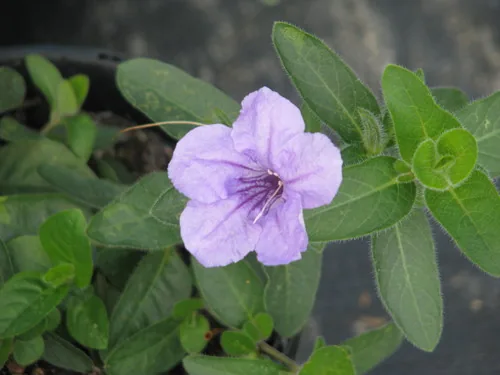
Prairie wild petunia (Ruellia humilis) is a low, spreading perennial of central North American dry prairies and glades, with lavender funnel flowers that last a day but repeat through warm months and hairy leaves that shrug at drought. Plants typically reach 6–18 inches (15–45 cm), rooting at nodes where stems touch soil. It is a quiet workhorse for dry rain-garden berms, rock gardens, and path edges that bake in summer. Full sun for densest bloom; light shade acceptable in hot climates. Well-drained, lean to average soils mimic glade truth; wet clay rots crowns. Drought-tolerant once established; water deeply only during prolonged dry spells in the first year. Divide clumps in spring; rooted layers transplant easily. Sow seed after last hard frost with surface press—germination warms with soil temperature above roughly 60°F (16°C). Cut back ragged stems after heavy bloom flushes to refresh foliage. Primarily ornamental—flowers are short-lived but produced in succession. Collect seed when capsules dry if expanding restoration patches. Peak bloom tracks heat waves through warm months, not imported holiday calendars.
Permaculture Functions
- Pollinator: Ruellia humilis short-tubed lavender funnels open at dawn for long-tongued bees and occasional hummingbirds where ranges overlap -- each corolla lasts a day but new buds march through heat waves.
- Ground Cover: Stems root at nodes into low mats along dry rain-garden berms and limestone glades without sprinkler entitlement -- tolerates drought once established; wet clay rots crowns honest and fast.
- Ornamental: Hairy gray-green foliage sets off repeated petunia-like blooms between little bluestem and purple lovegrass haze -- reads native-quiet compared with neon annual petunia flats.
- Wildlife Attractor: Succession bloom bridges mid-summer nectar gaps after early lupines finish -- small seeds feed sparrows if you let capsules mature away from paver cracks you dislike editing.
Companion Planting
- Overwatering and rich soil — sprawly growth with fewer flowers
- Confusion with cultivated petunias—verify hairy leaves and capsule shape before wild-food experiments
Threats & Pressure