About
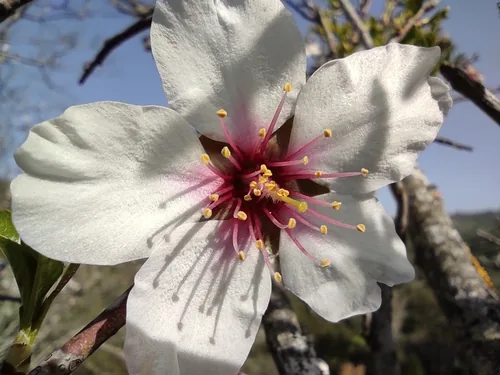
The almond tree (Prunus dulcis) is a deciduous tree native to the Middle East and South Asia. It typically grows to a height of 4–10 meters (13–33 feet) with a trunk diameter of up to 30 centimeters (12 inches). The tree produces beautiful white to pale pink flowers in early spring before the leaves emerge. The fruit is a drupe, consisting of an outer hull and a hard shell with the edible seed, commonly referred to as the almond nut, inside. Almond trees thrive in full sun, requiring at least 6–8 hours of direct sunlight daily. They prefer well-drained soils and are drought-tolerant once established but benefit from regular watering during dry periods, especially in the growing season. Almonds are commonly propagated by grafting onto rootstocks compatible with the soil and climate conditions. Seed propagation is possible but less common due to variability in fruit quality. Almonds are typically harvested in late summer to early autumn when the hulls split open, revealing the shell. The nuts are shaken from the tree and allowed to dry before storage.
Permaculture Functions
- Edible: Prunus dulcis yields sweet kernels inside woody shells once hulls split in late summer -- commercial types need compatible pollinizers, while backyard rows still demand prompt pickup before navel orangeworm and squirrel audits ruin the crop.
- Wildlife Attractor: Pale pink five-petaled flowers pack nectar on bare wood before many other rosaceous trees open -- pulls honeybees and mason bees through orchards on still mornings.
- Windbreaker: Multiple parallel rows of trained scaffolds slow desiccating wind across vegetable blocks and berry tunnels in Mediterranean-climate valleys -- keep crowns open so humid pockets do not harbor hull rot fungi.
- Border Plant: Small to medium deciduous crowns mark field edges and driveway entries with early bloom and summer shade -- root competition is real, so keep heavy feeders outside the drip line unless irrigated.
Companion Planting
Threats & Pressure
- Apple Maggot
- Bagworm
- Blackberry Psyllid
- Borers
- Cherry Fruit Fly
- Codling Moth
- Cyclamen Mite
- Fall Webworm
- Lesser Peachtree Borer
- Oriental Fruit Fly
- Oriental Fruit Moth
- Peach Twig Borer
- Peachtree Borer
- Pear Psylla
- Plum Curculio
- Raspberry Beetle
- Raspberry Cane Borer
- Rose Slug
- Sparganothis Fruitworm
- Spider Mites
- Spittlebugs
- Stink Bug
- Strawberry Root Weevil
- Twig Girdlers
- Vine Weevil
- Gall Mite
- Rust Mite
- Spotted Lanternfly
- Brown Marmorated Stink Bug
- Eastern Tent Caterpillar
- Harlequin Ladybird
- Tent Caterpillar