About
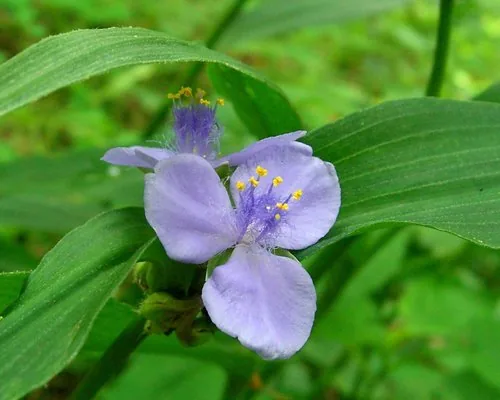
Zigzag spiderwort (Tradescantia subaspera) is a woodland perennial of eastern North America, with broader leaves than many tradescantias and stems that zigzag between nodes, bearing three-petaled blue-violet flowers opening fresh each morning. Plants reach 1–2 feet (30–60 cm), spreading into loose colonies in partial shade with steady moisture. It suits native shade borders and rain-garden shoulders where turf is a bad joke. Partial shade to light sun; afternoon shade reduces petal melt in heat. Moist, humus-rich, well-drained soils suit it; tolerates short dry spells once established with mulch. Avoid stagnant water over crowns. Divide clumps in spring; sow seed outdoors in fall. Primarily ornamental—flowers feed pollinators in late spring to summer. Deadhead near paths if spread is too chatty.
Permaculture Functions
- Pollinator: Tradescantia subaspera blue-violet flowers open fresh each cool morning -- small native bees work them before noon heat melts petals.
- Ground Cover: Zigzag stems spread loose colonies in moist shade -- broader leaves than Ohio spiderwort, easier to track in the field.
- Ornamental: Stem kinks between nodes give kinetic line in shade borders -- three-petaled blooms read simple up close.
- Wildlife Attractor: Understory insect habitat in layered forests -- deer sometimes browse; survivors refill from rhizomes.
Companion Planting
- Deep shade — fewer flowers despite polite silence about disappointment
- Confusion with other Tradescantia species—verify leaf width and stem zigzag before eating experiments
Threats & Pressure