About
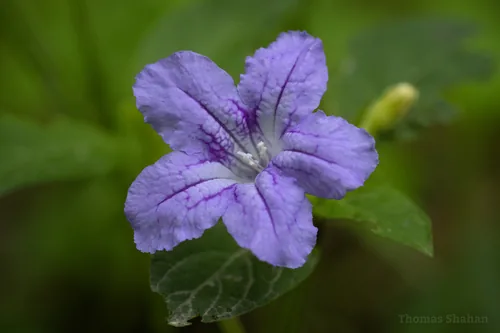
Wild petunia (Ruellia caroliniensis) is a low, spreading perennial of southeastern North American dry woodlands and glades, with lavender funnel flowers that last a day but repeat through warm months. Plants reach roughly 6–18 inches (15–45 cm), rooting at nodes. It suits dry shade borders, path edges, and pollinator strips where heat is honest. Full sun to light partial shade; more sun increases bloom in humid climates. Well-drained, lean to average soils suit it; tolerates drought once established. Avoid wet clay. Divide clumps in spring; sow seed after frost with surface press. Primarily ornamental—peak bloom tracks heat waves through warm months.
Permaculture Functions
- Pollinator: Ruellia caroliniensis lavender funnels open daily in heat -- long-tongued bees and occasional hummingbirds work the wide throat.
- Ground Cover: Stolons root at nodes forming 15--45 cm mats -- survives dry pine glades without sprinkler entitlement.
- Ornamental: One-day flowers repeat waves all summer -- silver little bluestem backdrop makes the lavender pop.
- Wildlife Attractor: Succession bloom covers midsummer nectar gaps when spring ephemerals are memory -- leave patches for skipper larvae where species overlap.
Companion Planting
Good Neighbors
Cautions
- Overwatering — sprawly growth with fewer flowers
Threats & Pressure
🐛 Pests