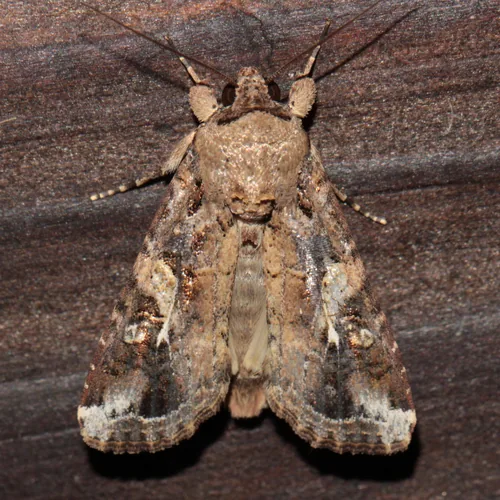
Field Identification
If leaves look shredded overnight or fruit has fresh chew holes, fall armyworm may be feeding right now. These larvae can eat fast and strip a healthy plant in a short window. Young stages are easy to miss, then damage suddenly explodes as they grow. Catch them early to avoid severe defoliation and contaminated harvests.
Check leaf undersides, growing tips, and stem junctions for eggs, frass pellets, and feeding scars. Larvae vary in color, but most have a soft segmented body and blend into foliage. Look at dusk or early morning when many species feed more actively. Fresh chewing plus live larvae or droppings on lower leaves confirms an active caterpillar outbreak.
Not sure what you have? Use the symptom diagnosis tool →
How to Deal With It
Organic Control Methods
Bacillus thuringiensis kurstaki (Bt) is highly effective on fall armyworm larvae under 1 inch — apply to whorls, leaf axils, and where larvae are feeding, not just leaf surfaces. Nuclear polyhedrosis virus (NPV) builds up naturally in large outbreaks and kills larvae — visible as blackened collapsing caterpillars. Trichogramma egg parasitoids attack fall armyworm eggs — support them with flowering plants like dill, fennel, and sweet alyssum nearby. Braconid and ichneumonid wasps parasitize larvae — avoid broad-spectrum sprays during peak flight periods.
Fall armyworm moths migrate north from tropical overwintering areas each spring — there are no local overwintering populations north of Florida. Peak damage comes from second and third generation moths in late summer. Early plantings escape the worst pressure. Bt spray programs must begin at first sign of egg masses or young larvae — once larvae reach 1 inch they move fast and Bt loses effectiveness. Pheromone traps monitor adult flights and indicate when to begin scouting intensively.
Fall armyworm is a generalist that attacks corn, sorghum, grasses, tomatoes, peppers, and many other crops — move through your whole garden when moths are active, not just corn. Intercrop with diverse flowering plants to support parasitoid populations. Destroy crop stubble immediately after harvest to eliminate pupation sites. Bats and insectivorous birds take large numbers of adult moths — bat boxes and bird habitat near gardens provide real pest suppression.
For corn, apply mineral oil to silks to prevent ear entry. Egg masses are laid on leaf surfaces in clusters of 100-200 covered with scales that look like fuzzy gray patches — crush on sight. Young larvae feed in groups before dispersing — finding and crushing these groups is the highest-value mechanical control. Netting over small garden plots excludes egg-laying moths entirely.
Bt kurstaki applied to whorls and leaf surfaces every 5-7 days during peak larval season — must contact larvae directly to work. Spinosad provides stronger activity on larger larvae and slightly longer residual than Bt — apply at dusk to minimize bee impact. Neem oil deters egg-laying and has some larval toxicity when applied to feeding surfaces. Apply all sprays in late afternoon or evening when moths are active and larvae are feeding, not during heat of day.
Let Nature Handle It
Natural Enemies
- Parasitic Wasps
- Predatory Stink Bugs
- Ground Beetles
- Birds
Threat Map