About
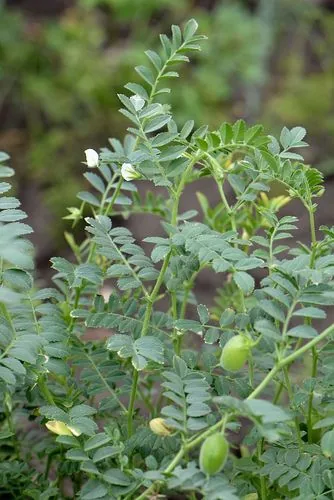
Chickpea (*Cicer arietinum*), also known as garbanzo bean, is an annual legume that grows up to 20–50 cm (8–20 inches) tall. It has small, feathery pinnate leaves and produces white, pink, or purple flowers. Each plant bears small, inflated pods containing 1–3 round seeds, which are widely consumed worldwide. Chickpeas thrive in arid and semi-arid climates due to their deep taproots that allow them to access groundwater efficiently. Chickpeas prefer full sun and well-drained soil with moderate moisture. They are drought-tolerant but require some irrigation during flowering and pod development. Propagation is done by direct seeding. Sow seeds 2.5–5 cm deep and space plants 7.5–15 cm apart in rows 45–60 cm apart. Best planted in early spring when soil temperatures reach at least 50°F (10°C). Harvest occurs when plants dry out and turn brown, typically 90–100 days after planting. Pods can be picked by hand or harvested mechanically.
Permaculture Functions
- Edible: Round seeds become hummus, roasted snacks, besan flour, and hearty soups once pods finish drying -- on bushy Cicer plants.
- Nitrogen Fixer: Root nodules with chickpea-specific rhizobia convert atmospheric nitrogen into plant protein and leave residual nitrogen -- in residues for the following crop.
- Ground Cover: Low, branching growth and senesced residues cover bare soil in annual rotations -- cutting splash erosion until the next crop is planted.
Threats & Pressure
- Aphids
- Banded Cucumber Beetle
- Bean Aphid
- Bean Leaf Beetle
- Bean Weevil
- Borers
- Corn Earworm
- Cowpea Curculio
- Cutworms
- Fall Armyworm
- Kudzu Bug
- Locust Borer
- Locust Leaf Miner
- Lubber Grasshopper
- Pea Moth
- Pea Weevil
- Reniform Nematode
- Root Aphid
- Soybean Looper
- Spittlebugs
- Stink Bug
- Striped Cucumber Beetle
- Spotted Cucumber Beetle
- Brown Marmorated Stink Bug
- Harlequin Ladybird
- Velvetbean Caterpillar