About
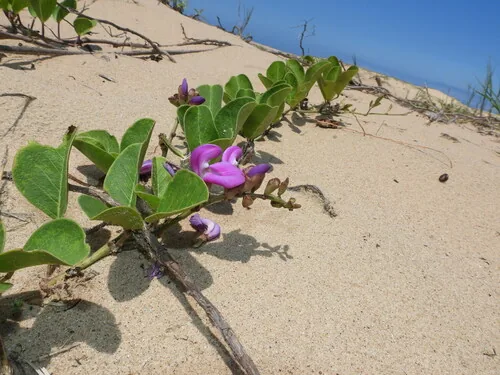
Bay bean (Canavalia rosea) is a pantropical creeping legume of beaches, dunes, and coastal roadsides, forming long trailing stems with trifoliate leathery leaves and pink-purple pea flowers followed by long pods. It carpets sand where salt spray and shifting substrate exclude most crops, stabilizing foredunes and berm edges in humid subtropical to tropical climates. Growth is low and spreading, rooting at nodes, with stems potentially spanning many feet along the ground. Full sun; requires free-draining sand and tolerates salt aerosols and occasional saltwater overwash better than inland legumes. Low to moderate rainfall once established; irrigate young plantings in dry season to speed coverage. Avoid heavy clay inland soils that hold cold wet in marginal winters. Direct-sow scarified seed into warm sand after frost danger in marginal zones; year-round in true tropics. Take nodal cuttings with roots attached from runners; keep humid until anchored. Do not move beach collections where local laws protect native dunes—use nursery-grown seed sources. Pods and seeds can be toxic if unprepared; treat as erosion-control and wildlife plant unless you have expert processing knowledge. Trim runners to direct growth along desired dune lines before wet season storms. Document coverage seasonally for restoration monitoring.
Permaculture Functions
- Nitrogen Fixer: Canavalia rosea rhizobia nodulate roots on foredunes so litter feeds sea oats and saltwort next bands upslope -- scarify seed hot-water style before sowing restoration plugs.
- Erosion Control: Node-rooting runners knit sand after storms when wrack buries stems -- steer mats with sand trenches before vines swallow boardwalk stakes.
- Ground Cover: Trifoliate leathery leaves tile upper beach where turf dies from salt -- midday glare still burns young cuttings unless you irrigate through first dry weeks.
- Wildlife Attractor: Pink-purple pea flowers feed coastal bees while mats shelter ghost crabs and plover chicks where dogs are actually leashed -- seeds stay toxic unless traditional detox is your documented skill.
Companion Planting
Also mentioned as companions:
- Sea Oats
Not yet profiled in PermiePortal
- Unverified seed toxicity — do not experiment with food use from wild pods without credible processing protocols
- Invasive potential outside native range — check regional lists before introducing to new coasts
Threats & Pressure
- Banded Cucumber Beetle
- Bean Aphid
- Bean Leaf Beetle
- Bean Weevil
- Corn Earworm
- Cowpea Curculio
- Fall Armyworm
- Kudzu Bug
- Locust Borer
- Locust Leaf Miner
- Lubber Grasshopper
- Pea Moth
- Pea Weevil
- Reniform Nematode
- Root Aphid
- Soybean Looper
- Spittlebugs
- Stink Bug
- Striped Cucumber Beetle
- Spotted Cucumber Beetle
- Brown Marmorated Stink Bug
- Harlequin Ladybird
- Velvetbean Caterpillar