About
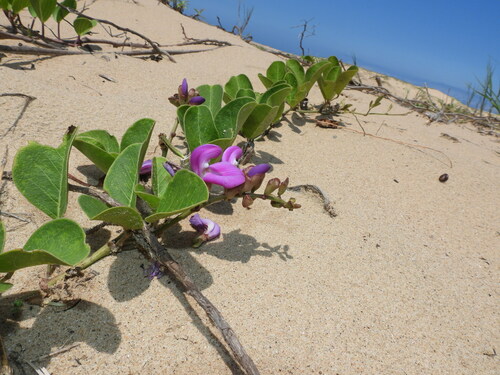
Mangrove bean here refers to the coastal legume Canavalia rosea, a salt-spray–tolerant vine that carpets dunes and upper beach margins with trifoliate leaves and showy pink-purple pea flowers. Stems root at nodes, climb low scrub, and stabilize sand where casual turf dies of attitude. In subtropical and tropical Americas it is a native-aligned strand plant for restoration-minded growers—respect local regulations on coastal work, avoid introducing genetics outside their home ecoregion, and never treat wild seeds as automatic food without expert ID and preparation knowledge. It fixes nitrogen where few other legumes tolerate salt mist. ☀️💧 Sun and Water Requirements: - Full sun on open coasts; tolerates bright exposure with ocean wind. - Sandy, well-drained substrate; occasional salt spray is part of life—avoid freshwater bogging behind seawalls. - Rainfall usually sufficient; irrigate only to establish transplants in artificial berms. ✂️ Propagation: - Seeds: scarify hard seeds, soak overnight, sow warm after danger of chilling on exposed sites. - Layering: bury nodal sections while attached to mother vines during warm wet season. - Cuttings from semi-woody runners root quickly in sand under humidity. 🌾 Harvest / Best Use Timing: - For seed, collect pods when mature but before storm scatter if you are banking local genetics responsibly. - For mulch, trim excess growth after flowering to feed path-side dunes without smothering native neighbors.
Permaculture Functions
- Nitrogen Fixer: Root nodules enrich impoverished beach sand for associated strand species.
- Ground Cover: Matting stems reduce erosion during storms and foot traffic zones.
- Erosion Control: Holds foredune faces where purely ornamental groundcovers wash away.
- Wildlife Attractor: Flowers feed pollinators; pods feed beach wildlife where land ethics allow sharing.
Coastal legume infrastructure:
Practitioner Notes
- Chop-and-drop timing matters: green mulch feeds soil; woody brown mulch ties up surface nitrogen briefly.
- Foot traffic after establishment only—early walks tear stems and invite weeds in the wounds.
- Soil smell and root color tell more than gadget overload—dig a small hole twice a season.
- Do not yank test nodules off every root—sacrifice one plant, not the whole stand’s recovery.
Companion Planting
- Beach Strawberry — low fruiting ground layer shares upper beach light without duplicating the climbing habit.
- Saltbush — halophyte neighbor tolerates similar salt mist while occupying slightly higher, drier micro-niches.
- Pandanus — structural coastal plant provides dappled support for occasional bay bean stems without chemical warfare.
- English Ivy
- Japanese Honeysuckle
Pest Pressure