About
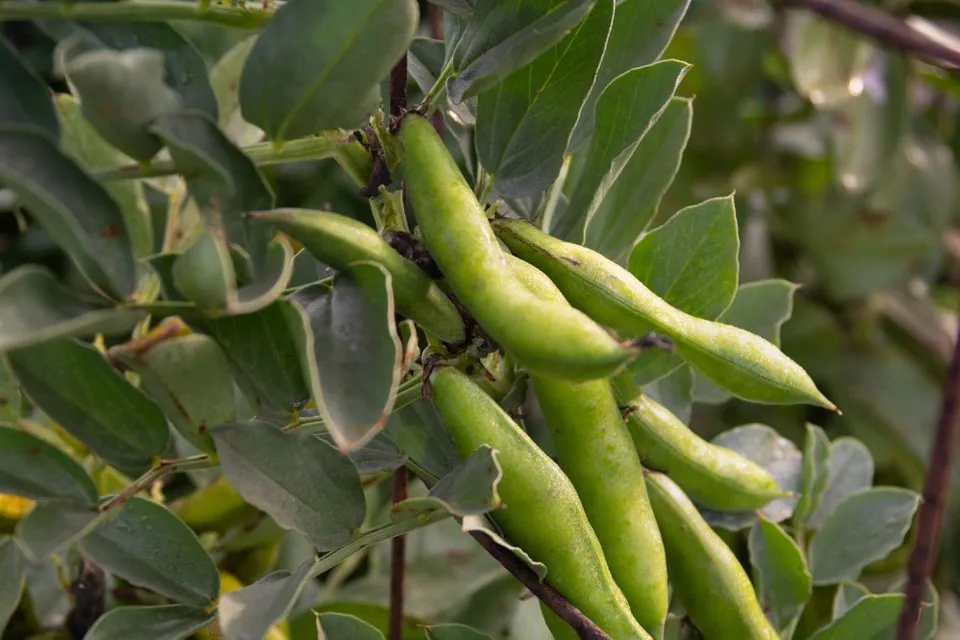
Fava bean (*Vicia faba*), also known as broad bean, is an annual legume that can grow up to 1.8 meters (6 feet) tall. It has stout, erect stems with large, leathery leaves composed of 2–7 leaflets. The plant produces clusters of white or purplish flowers, leading to large, green pods containing 3–8 seeds each. Fava beans are known for their hardiness and can tolerate cooler temperatures, making them suitable for early spring or late autumn planting. Fava beans prefer full sun but can tolerate partial shade. They thrive in well-drained, fertile soil with consistent moisture. Regular watering is essential, especially during flowering and pod development. Propagation is through direct seeding. Sow seeds 5 cm deep and 15–20 cm apart in rows spaced 60–90 cm apart. In mild climates, seeds can be sown in late autumn for an early spring harvest; in colder regions, sow in early spring. Harvesting occurs when pods are fully formed and seeds have reached desired size. Young pods can be picked for fresh consumption, while mature pods are left to dry for storage beans.
Permaculture Functions
- Edible: Young green pods shell easily for fresh favas that need their inner skins slipped after blanching -- mature dried beans store for years and become the backbone of ful medames, soups, and paste.
- Nitrogen Fixer: Vicia faba nodulates heavily with Rhizobium leguminosarum -- inoculate first sowing in new ground and expect 100-200 lbs of fixed nitrogen per acre to stay in the root mass when you chop-and-drop the spent plant.
- Dynamic Accumulator: Deep taproot loosens compacted clay and pulls calcium and phosphorus into leaf tissue -- whole-plant incorporation before seed set returns those minerals to the topsoil faster than composting harvested residue separately.
- Animal Fodder: Whole dried beans and cooked leaf material are high-protein livestock feed accepted by chickens, goats, and cattle -- raw mature beans contain vicine and can cause favism in humans with G6PD deficiency; cook thoroughly for human use.
Threats & Pressure
- Aphids
- Banded Cucumber Beetle
- Bean Aphid
- Bean Leaf Beetle
- Bean Weevil
- Brown Marmorated Stink Bug
- Corn Earworm
- Cowpea Curculio
- Fall Armyworm
- Harlequin Ladybird
- Kudzu Bug
- Locust Borer
- Locust Leaf Miner
- Lubber Grasshopper
- Pea Moth
- Pea Weevil
- Reniform Nematode
- Root Aphid
- Soybean Looper
- Spittlebugs
- Spotted Cucumber Beetle
- Stink Bug
- Striped Cucumber Beetle
- Velvetbean Caterpillar