About
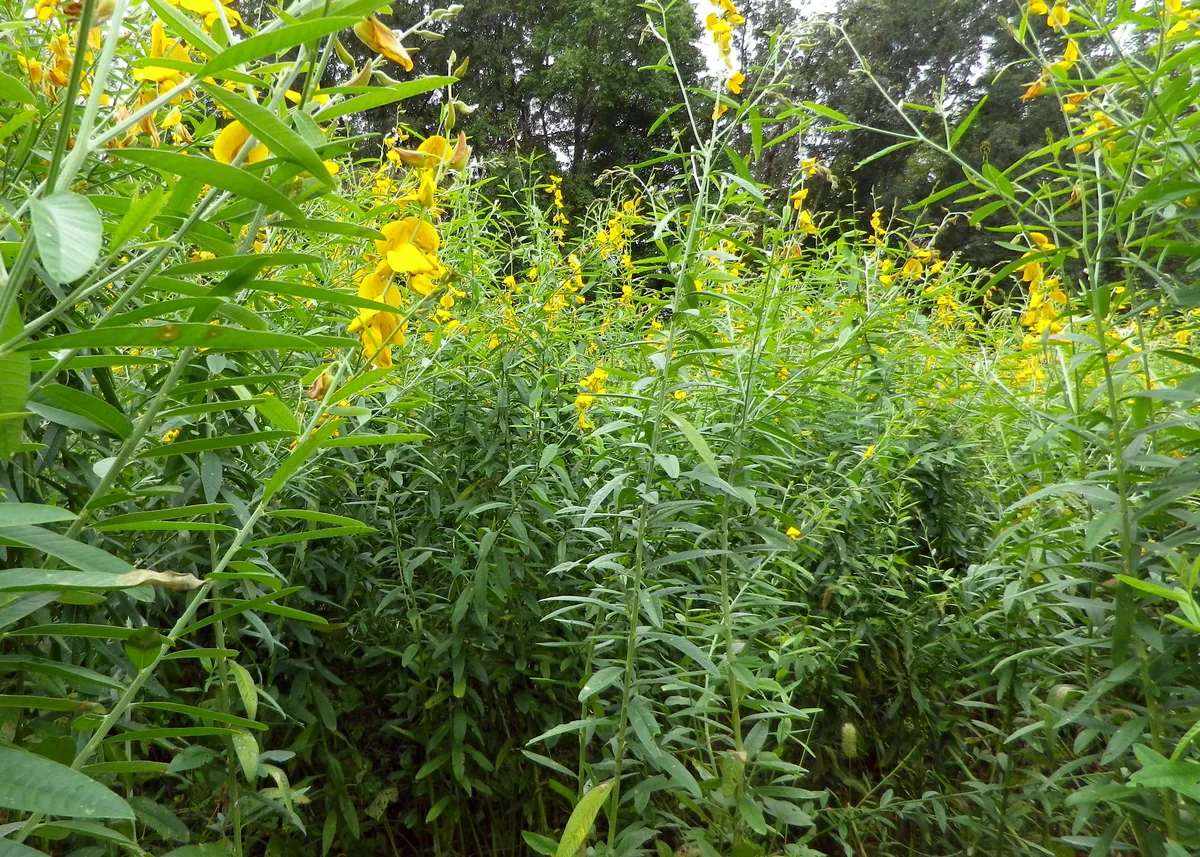
Sun Hemp (*Crotalaria juncea*) is a fast-growing annual legume primarily cultivated as a cover crop and green manure. It grows upright, reaching heights of 1 to 3.5 meters (3 to 11.5 feet) with fibrous, ridged stems. The leaves are oblong-lanceolate, spirally arranged along the stem, measuring 4 to 12 centimeters (1.5 to 4.7 inches) in length. It produces bright yellow, pea-like flowers in terminal clusters, followed by small seed pods containing black or brown seeds. Its deep taproot improves soil aeration while fixing nitrogen into the soil. 🫘 Methods to Propagate: Sun Hemp is best propagated through direct seeding. Seeds should be sown at a depth of 1.5 to 2.5 centimeters (0.6 to 1 inch) in warm, well-drained soil when temperatures exceed 20°C (68°F). Germination occurs within 3 to 7 days. 🌞💧 Sun and Water Requirements: This plant thrives in full sun and prefers well-drained sandy or loamy soils with a neutral to slightly acidic pH. It is drought-tolerant but benefits from occasional watering in dry conditions. 🧑🌾👩🌾 When to Harvest: If used as green manure, Sun Hemp should be incorporated into the soil before flowering (around 8 to 12 weeks after planting). For fiber production, it should be harvested at full bloom when stems are at their strongest.
Permaculture Functions
- Nitrogen Fixer: Crotalaria juncea nodulates aggressively in tropical heat -- knock down stands before woody lignin spikes so nitrogen tied in tissue returns green.
- Mulcher: Six-foot woody stems slash into mulch that suppresses weeds -- time cuts before pods mature their alkaloids to avoid soil contamination.
- Dynamic Accumulator: Deep taproots mine subsoil phosphorus on worn cotton fields -- tissue tests show spikes in potassium and micronutrients ready for compost windrows.
- Erosion Control: Fast canopy closes rows on slopes -- prevents sheet-wash on bare ground between tree crops during summer storms.
- Biofuel: High cellulose tonnage feeds pellet trials -- and anaerobic digestors on farms already metering moisture into methane tanks.
Companion Planting
Threats & Pressure
- Aphids
- Banded Cucumber Beetle
- Bean Aphid
- Bean Leaf Beetle
- Bean Weevil
- Borers
- Corn Earworm
- Cowpea Curculio
- Fall Armyworm
- Kudzu Bug
- Locust Borer
- Locust Leaf Miner
- Lubber Grasshopper
- Pea Moth
- Pea Weevil
- Reniform Nematode
- Root Aphid
- Rootknot Nematodes
- Soybean Looper
- Spittlebugs
- Stink Bug
- Striped Cucumber Beetle
- Spotted Cucumber Beetle
- Brown Marmorated Stink Bug
- Harlequin Ladybird
- Velvetbean Caterpillar