About
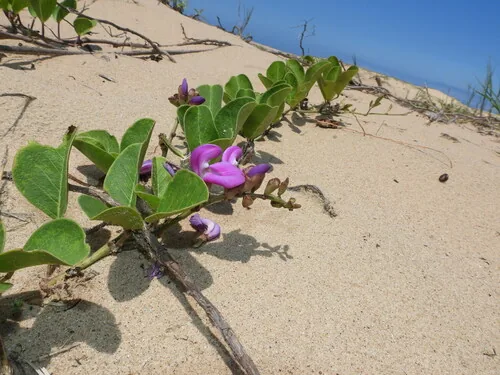
Beach bean (Canavalia maritima) is a robust coastal legume of tropical and subtropical shorelines, producing thick trailing stems, large leathery trifoliate leaves, and showy pink to purple pea flowers followed by long woody pods. It colonizes upper beaches and frontal dunes where salt spray, heat, and shifting sand stress ordinary crops, knitting sand with nodal roots and feeding succession with nitrogen-rich litter. Individual patches can spread widely along favorable coasts in the wet season growth pulse. Full sun essential; thrives in well-drained sandy soils with occasional salt exposure. Tolerates drought between rains once rooted; supplemental water speeds establishment during dry season stabilization projects. Poor performance on waterlogged muck or heavy inland clays without excellent drainage. Sow scarified seed into warm sand; protect from crabs and rodents on restoration sites with temporary mesh. Root stem cuttings with at least one node buried. Coordinate collections with local conservation rules—wild dunes are not a free nursery. Treat primarily as stabilization and ecology; seeds require careful preparation and are not casual food. Clip excessive runners to steer mats along design contours before storm season. Photograph phenology for grant reporting rather than chasing edible yields.
Permaculture Functions
- Nitrogen Fixer: Canavalia maritima nodules bank nitrogen in upper beach sand where organic matter is nearly zero -- inoculate restoration plugs if site history lacks native legume rhizobia.
- Erosion Control: Leathery runners capture storm wrack and build foredune height while reducing surface creep -- trim seaward tips before hurricane season if mats climb over turtle signage stakes.
- Ground Cover: Rapid lateral growth drops midday sand temperature a few degrees for hatchling niches -- still avoid planting seaward of local protection lines where law says hands off.
- Wildlife Attractor: Showy pink-purple papilionaceous flowers feed coastal halictid bees while dense mats shelter ghost crabs -- seed chemistry stays toxic to casual human snackers without traditional processing.
Companion Planting
Threats & Pressure
- Aphids
- Banded Cucumber Beetle
- Bean Aphid
- Bean Leaf Beetle
- Bean Weevil
- Corn Earworm
- Cowpea Curculio
- Fall Armyworm
- Kudzu Bug
- Locust Borer
- Locust Leaf Miner
- Lubber Grasshopper
- Pea Moth
- Pea Weevil
- Reniform Nematode
- Root Aphid
- Soybean Looper
- Spittlebugs
- Stink Bug
- Striped Cucumber Beetle
- Spotted Cucumber Beetle
- Brown Marmorated Stink Bug
- Harlequin Ladybird
- Velvetbean Caterpillar