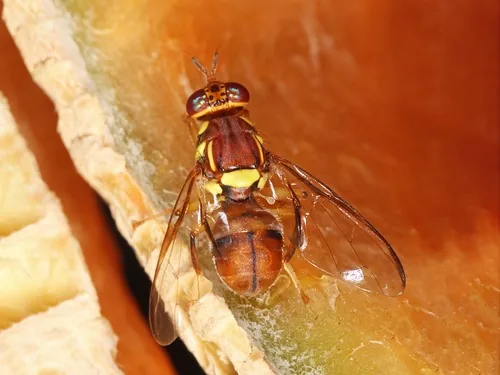
Field Identification
If leaves show trails, fruit turns soft, or roots collapse from inside, oriental fruit fly may already be feeding. The larval stage does most of the damage, often hidden where you cannot see it at first glance. By the time yellowing or rot appears, feeding may be well underway. Move quickly when symptoms begin to prevent another wave of eggs and larvae.
Watch for tiny eggs near plant tissue, pale legless larvae inside mines or fruit, and sudden soft spots or tunnels. Adults are usually small flies that hover or dart when disturbed. Check around wounds, blossoms, and moist plant debris where egg-laying is common. Cut open suspect tissue: live maggots or fresh tunnels are the clearest field confirmation.
Not sure what you have? Use the symptom diagnosis tool →
How to Deal With It
Organic Control Methods
Classical parasitoids including Fopius arisanus (egg-larval parasitoid) and Diachasmimorpha longicaudata (larval parasitoid) have been released in Hawaii and Pacific islands with significant success. These are part of government biocontrol programs rather than commercially available to home gre they are established, avoid broad-spectrum sprays that would suppress these populations. Generalist predators have limited impact on fruit fly larvae inside fruit — prevention and exclusion are more effective than biological control for this pest.
Oriental fruit fly is a quarantine pest in the continental US — if you suspect it, contact your state department of agriculture immediately. It stings ripening fruit to lay eggs inside, and larvae destroy the fruit from within before obvious external damage appears. Ripe and overripe fruit on or under trees is the primary breeding site — remove all fallen fruit daily and bag or destroy it. Never leave ripe fruit hanging past peak maturity.
Remove all fallen and overripe fruit from the ground daily — this is the single most important management step. Double-bag infested fruit in heavy plastic and leave in the sun for several days before disposal to kill larvae inside. Strip backyard and roadside host trees of overripe fruit during outbreak periods. This is fundamentally a community-scale pest — one unmanaged backyard mango or guava tree produces thousands of adults that spread to neighboring properties.
Individual fruit bagging with paper or fine mesh bags after fruit set physically excludes egg-laying adults — highly effective for high-value fruit like mangoes and papayas. Male annihilation devices using methyl eugenol lure plus toxicant kill male flies and reduce mating success — these are used in regulatory programs and some are available to home growers. Protein bait stations attract and kill adults of both sexes.
Protein bait sprays (hydrolyzed protein plus spinosad) target feeding adults and are the most effective organic spray option — spot or strip applications spare non-target insects. Apply in small patches on foliage rather than full coverage — adult flies will find the bait without you spraying the whole tree. Kaolin clay on fruit reduces egg-laying by deterring females from landing.
Let Nature Handle It
Natural Enemies
- Fopius arisanus
- Diachasmimorpha longicaudata
- Diachasmimorpha tryoni
Threat Map