About
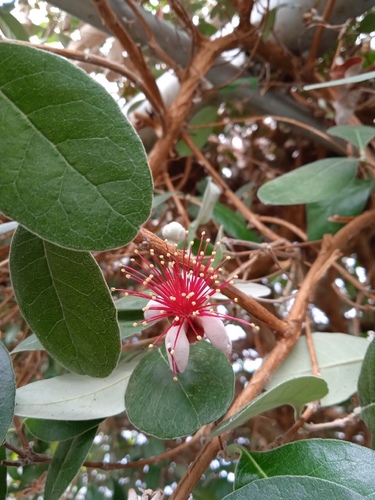
Feijoa (Acca sellowiana) is an evergreen shrub or small tree in the myrtle family, native to highland subtropical South America — southern Brazil, Uruguay, Paraguay, and northern Argentina. It typically reaches 10–15 feet (3–4.5m) as a shrub, taller when trained as a tree. Leaves are oval, leathery, and distinctively silver-felted on the undersides. Flowers are showy with thick white petals and a burst of red stamens — both flowers and fruit are edible. Fruit is oval, green-skinned with cream jelly-like pulp that tastes like pineapple crossed with guava and mint. Hardy to around 12°F (-11°C) when established; young wood more vulnerable. ☀️💧 Sun and Water Requirements: - Full sun produces heaviest fruit; afternoon shade reduces scorch in hottest climates. - Well-drained loam preferred; drought-tolerant once established but fruits better with consistent moisture. - Avoid standing water — roots rot in poorly drained soil. - Wind protection improves fruit set in exposed sites. ✂️ Methods to Propagate: - Cuttings: semi-hardwood in late summer under humidity dome; rooting takes 6–8 weeks. - Grafting: named varieties grafted for reliable fruit quality and self-fertility. - Seeds: germinates readily but offspring are variable — useful for breeding, not for cloning a known cultivar. 🌾 Harvest / Best Use Timing: - Fruit ripens fall through early winter depending on variety and location. - Ripe fruit falls from the tree — collect from the ground daily during peak drop. - Shelf life is extremely short — 2–3 days at room temperature, up to a week refrigerated. - Eat fresh by slicing equatorially and scooping pulp; skin is edible but tannic. - Process surplus immediately into jam, chutney, wine, or freeze pulp for later use.
Permaculture Functions
- Edible: Fruit pulp, flowers (petals), and young leaves are all edible with distinctive
- pineapple-mint-guava flavor; flowers can be eaten directly off the plant.
- Ornamental: Evergreen with attractive silvery leaf undersides; flowers are genuinely
- beautiful — white petals with crimson stamens that stand out in the landscape.
- Windbreaker: Dense evergreen habit makes an effective hedge or windbreak when planted
- in rows; tolerates hard shearing.
- Wildlife Attractor: Flowers are pollinated by birds (petals attract them) and bees;
- fallen fruit feeds ground-feeding birds and small mammals.
- Pollinator: Unusual bird-pollinated flowers — honeyeaters and similar species are
- primary pollinators in native range; bees also work the flowers effectively.
Practitioner Notes
- Fruit drops when fully ripe — collect from the ground daily, not from the tree.
- Shelf life is 2–3 days at room temperature; process or refrigerate immediately after harvest.
- Most varieties need a pollination partner — even "self-fertile" clones produce more with a second variety nearby.
- Flowers are edible — thick white petals have a sweet floral flavor worth eating directly.
- Established plants tolerate moderate drought but fruit size and quality drop significantly without consistent moisture during fruit development.
Companion Planting
- Comfrey — dynamic accumulator planted at drip line; chop-and-drop feeds feijoa roots
- Strawberry — low ground cover under canopy uses space without competing for resources
- Lemongrass — aromatic pest confuser at perimeter; similar drainage preferences
- Blueberry — similar pH and drainage needs; extends harvest season in the same guild
- Heavy wet clay without raised mounding — root rot ends the conversation
- Single-tree plantings expecting full crops — most varieties need cross-pollination
- Hard freezes below 12°F (-11°C) on young wood without mulch protection
Pest Pressure