About
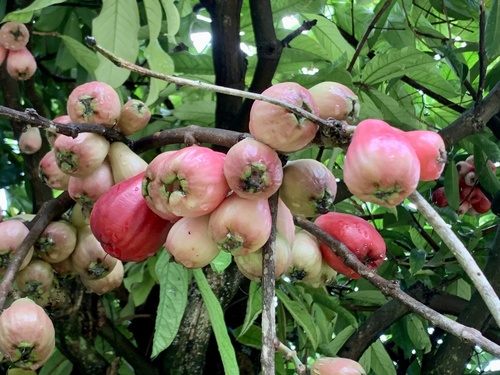
Otaheite apple (Syzygium malaccense) is the island-market name for a tropical myrtle tree valued for bell-shaped, often crimson-blushed fruit with crisp white flesh and a mild, rose-apple sweetness. Trees reach 40–60 feet (12–18 m) in sheltered humid sites, flushing bronze-red new growth between showy flower bursts. It belongs in equatorial and humid subtropical home orchards where heat is reliable and frost is a rare headline, not a lifestyle. ☀️💧 Sun and Water Requirements: Full sun for dense flowering and fruiting; partial shade acceptable for juveniles. Rich, well-drained soil with steady moisture in the warm wet season and irrigation during dry spells prevents fruit drop. Protect from strong salt winds; large leaves tatter when exposed. ✂️ Propagation: Air-layer elite trees or graft onto seedling rootstocks for predictable fruit. Seeds grow quickly but vary in quality—fine for experiments, risky for commerce. Prune for a single trunk in windy sites, then open the crown for light on fruiting wood. 🌾 Harvest / Best Use Timing: Pick when skin colors deepen and flesh yields slightly—lines vary from white to deep wine-red. Eat fresh within days; thin skin bruises if tossed. Peak loads follow local heat and rainfall patterns rather than temperate calendars.
Permaculture Functions
- Edible: Fresh fruit offers hydration-forward snacks and salads where sugar bombs are not mandatory.
- Shade Provider: Wide crown shelters understory vanilla, cacao seedlings, or human hammocks.
- Wildlife Attractor: Masses of flowers feed bees and flies; fruit feeds birds where sharing is acceptable.
- Ornamental: Red leaf flushes justify front-yard placement even before fruit sets.
Practitioner Notes
- Otaheite vs Malay vs Mountain is marketing, not taxonomy—Syzygium malaccense is the boring answer that saves money.
- If you plant two “different” trees and they look married, you cloned the same species twice—congratulations.
- Fruit flies love ground drops—sanitize like you mean it or accept larvae confetti.
- Red new leaves fade—if they never appear, check nitrogen humility versus actual starvation.
Companion Planting
- Mountain Apple — same species under another common label; plant once, not twice, unless you enjoy duplicate driplines
- Carambola Tree — contrasting fruit geometry and harvest timing in a tropical canopy row
- Ginger — shade-tolerant rhizome along the eastern dripline where mulch stays deep
- Duplicate common names for Syzygium malaccense—this entry matches Mountain Apple and Malay Apple listings
- Frost near 30°F (-1°C) damages young growth—protect saplings on marginal sites
Pest Pressure