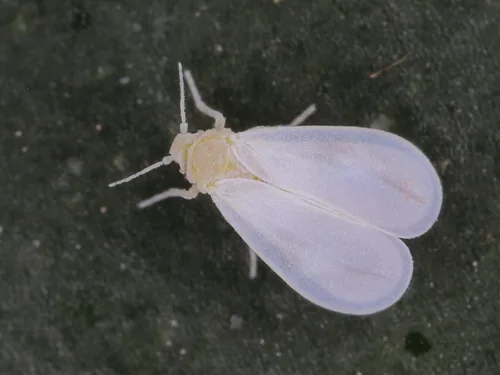
Field Identification
If leaves show trails, fruit turns soft, or roots collapse from inside, greenhouse whitefly may already be feeding. The larval stage does most of the damage, often hidden where you cannot see it at first glance. By the time yellowing or rot appears, feeding may be well underway. Move quickly when symptoms begin to prevent another wave of eggs and larvae.
Watch for tiny eggs near plant tissue, pale legless larvae inside mines or fruit, and sudden soft spots or tunnels. Adults are usually small flies that hover or dart when disturbed. Check around wounds, blossoms, and moist plant debris where egg-laying is common. Cut open suspect tissue: live maggots or fresh tunnels are the clearest field confirmation.
Not sure what you have? Use the symptom diagnosis tool →
How to Deal With It
Organic Control Methods
Encarsia formosa and Eretmocerus eremicus are parasitic wasps specifically bred for whitefly control in protected culture — standard practice in commercial greenhouses. Release preventively before populations build, at 1 card per 10 square feet every 2 weeks. They need temperatures above 64F (18C) to be effective. Delphastus catalinae is a small black beetle that eats large numbers of whitefly eggs and nymphs — effective when whitefly populations are already established. Preserve all these beneficials by avoiding broad-spectrum sprays and only spot-treating hot spots.
Greenhouse whitefly spreads almost exclusively on infested plant material — inspect every new plant before bringing it inside, where nymphs and eggs cluster. Yellow sticky cards at plant height are essential monitoring tools — hang one per 100 square feet and check weekly. More than 10 adults per card per week means a population is establishing. Excess nitrogen produces the lush soft growth whiteflies prefer — avoid overfeeding. Reflective mulch in outdoor beds confuses adults and reduces landing rates.
Remove heavily infested lower leaves immediately and bag them — whitefly nymphs on removed leaves will still develop and emerge as adults if composted. Keep weeds near greenhouse structures mowed — many weed species host whitefly populations that reinvade. Maintain 60-80F (15-27C) temperature range where possible — extreme heat accelerates whitefly development faster than parasitoids can track. Space plants for air circulation to slow spread between plants.
Yellow sticky cards at plant height trap large numbers of adults and are your most reliable early warning system. A handheld vacuum in early morning when adults are sluggish removes significant populations quickly — especially effective in enclosed spaces. Strong water spray dislodges adults and nymphs from undersides of leaves — repeat every 2-3 days for 2 weeks.
Insecticidal soap (1-2 teaspoons castile soap per quart water) kills nymphs on contact — coat leaf undersides thoroughly where nymphs cluster. Apply every 3 days for 2 weeks. Neem oil disrupts whitefly development and reduces egg-laying — mix 1 tablespoon neem plus 1 teaspoon castile soap per quart warm water, apply weekly. Beauveria bassiana fungal spray infects and kills nymphs — effective in humid conditions above 70% relative humidity. Apply all sprays at dusk to protect beneficials and avoid leaf burn.
Let Nature Handle It
Natural Enemies
- Encarsia formosa
- Eretmocerus spp.
- Delphastus catalinae
- Lacewings
Threat Map