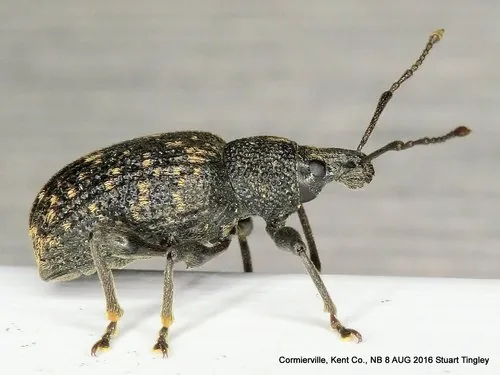
Field Identification
If plants are wilting, notching at the edges, or fruit and roots show hidden feeding damage, vine weevil may be the cause. Adults chew above ground while larvae often feed out of sight inside soil, stems, or fruit. Damage builds quietly, then plants crash fast when roots are heavily hit. Act early so a small weevil problem does not become a season-long infestation.
Look for small beetles with a hard body and a distinct snout, usually active at dawn, dusk, or night. Check for crescent-shaped leaf notches, punctures in fruit, or tiny entry holes near stems. In soil or damaged tissue, larvae are often pale, legless, and curved in a C-shape. Fresh chew marks plus snout beetles or C-shaped grubs confirm active weevil pressure.
Not sure what you have? Use the symptom diagnosis tool →
How to Deal With It
Organic Control Methods
Steinernema kraussei nematodes are specifically adapted to cool soil temperatures (above 41F/5C) making them ideal for early spring and fall applications when vine weevil larvae are most active. Heterorhabditis bacteriophora works in warmer soil above 59F (15C). Apply as a drench to moist growing media thoroughly and keep moist for 2 weeks. Beauveria bassiana as a soil drench supplements nematode programs. Rotate nematode species seasonally -- S. kraussei in cool periods, H. bacteriophora in warm periods.
Vine weevil adults notch leaf margins in a characteristic scalloped pattern -- the unmistakable sign is smooth U-shaped notches along leaf edges appearing overnight. Adults feed at night and hide in soil or pot rims during the day. Larvae do the most serious damage underground, destroying roots until plants suddenly collapse. Inspect all incoming container plants carefully -- vine weevil spreads almost exclusively on infested nursery stock. Quarantine new batches for 2 weeks before mixing with existing plants.
Raise container plants on gravel or mesh benches to reduce adult hiding spots directly under pots. Empty and refresh heavily infested potting media rather than repeatedly treating -- larvae can reach high densities in container roots. Inspect container roots when repotting -- C-shaped white grubs in the root zone are vine weevil larvae. Remove and destroy them manually before repotting into fresh sterile media.
Place boards, burlap, or damp newspaper near infested plants overnight -- adults shelter under them and can be collected and destroyed in the morning. Hand-pick adults at night with a headlamp -- slow but satisfying for backyard berry patches. Sticky barriers on pot rims or bench legs prevent adults from climbing. For backyard shrubs and strawberries, a sheet under the plant and vigorous shaking at night collects adults.
Entomopathogenic nematodes as media or soil drench are the primary organic treatment for larvae -- S. kraussei for cool conditions, H. bacteriophora for warm. Surface pyrethrin or insecticidal soap at dusk targets adults feeding on foliage -- apply at least twice weekly during peak adult emergence in late spring and again in late summer. Beauveria bassiana soil drench for larvae where labeled. No spray reaches larvae effectively once they are established in root zones -- nematodes are the only option that works underground.
Let Nature Handle It
Natural Enemies
- Steinernema kraussei
- Heterorhabditis bacteriophora
- Beauveria bassiana
- Ground Beetles (Carabidae)
Threat Map