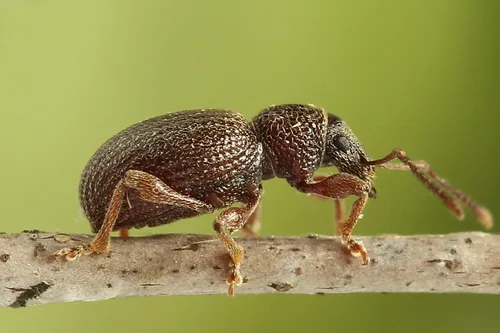
Field Identification
If plants are wilting, notching at the edges, or fruit and roots show hidden feeding damage, strawberry root weevil may be the cause. Adults chew above ground while larvae often feed out of sight inside soil, stems, or fruit. Damage builds quietly, then plants crash fast when roots are heavily hit. Act early so a small weevil problem does not become a season- long infestation.
Look for small beetles with a hard body and a distinct snout, usually active at dawn, dusk, or night. Check for crescent-shaped leaf notches, punctures in fruit, or tiny entry holes near stems. In soil or damaged tissue, larvae are often pale, legless, and curved in a C-shape. Fresh chew marks plus snout beetles or C-shaped grubs confirm active weevil pressure.
Not sure what you have? Use the symptom diagnosis tool →
How to Deal With It
Organic Control Methods
Steinernema feltiae and Heterorhabditis bacteriophora nematodes applied as soil drenches are the most effective biological control for strawberry root weevil larvae in root zones -- apply when soil is moist and above 50F (10C). Repeat every 6-8 weeks during the growing season in sandy fast-draining soils that require more frequent application. Ground beetles and ants consume adults and larvae in soil. Beauveria bassiana fungal products suppress larvae in moist soil conditions. Maintain diverse flowering groundcovers in drive rows to support generalist predators.
Strawberry root weevil adults notch leaf margins in characteristic smooth scalloped cuts -- the sign is neat curved notches along leaf edges appearing overnight. Adults are flightless and must walk to new plants, making rotation to clean ground highly effective. Larvae feed on roots underground causing plants to wilt and decline without obvious above-ground cause -- dig declining plants and check for C-shaped white grubs in the root zone. Inspect all new transplants for adults and root grubs before planting.
Rotate strawberry beds to new ground on a planned 2-3 year cycle -- adults are flightless and cannot easily colonize new sites far from the previous planting. Avoid bringing infested soil on tools between clean and infested areas. Solarize vacated beds during summer to kill larvae and pupae before the next planting. Flame or mow old foliage after renovation timing to avoid crown damage -- this removes adult cover and egg-laying sites.
Place boards or burlap near infested plantings overnight -- flightless adults shelter under them and can be collected and destroyed in the morning. Sticky barriers on low bed frames and raised bed walls prevent adult movement between beds. Harvest all ripe fruit promptly -- overripe fruit on the ground provides feeding sites that concentrate adults for easier removal.
Entomopathogenic nematodes (Steinernema spp., Heterorhabditis spp.) as soil drench are the primary organic treatment -- saturate the root zone thoroughly and keep moist for 2 weeks after application. Repeat applications are needed in sandy soils. Pyrethrin at dusk targets adults feeding on foliage -- apply at least twice weekly during peak adult emergence. Beauveria bassiana soil drench for larvae where labeled and soil moisture favors fungal activity.
Let Nature Handle It
Natural Enemies
- Entomopathogenic Nematodes
- Ground Beetles (Carabidae)
- Ants (Formicidae)
- Insectivorous Birds
Threat Map