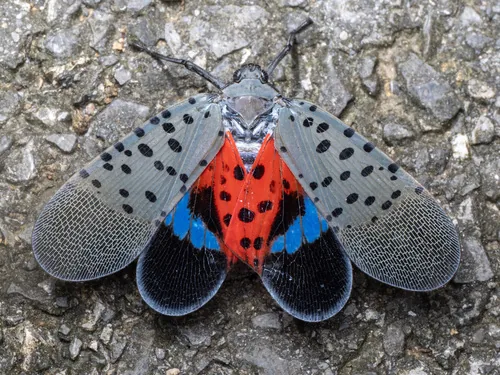
Field Identification
If leaves, stems, or fruit suddenly look spotted, sunken, or rotting, spotted lanternfly may already be active. This problem often starts small, then spreads across healthy tissue before most growers realize how serious it is. Warmth, moisture, and crowded foliage usually speed it up. Treat early, because waiting even a few days can turn a manageable infection into major crop loss.
Look for a pattern, not one bad leaf: expanding spots, dark or pale halos, fuzzy growth, or tissue that collapses when touched. Check both leaf surfaces, stem bases, and fruit scars where symptoms first appear. New lesions after rain, overhead watering, or heavy dew are a strong clue. When separate spots begin merging into larger dead patches, the disease is advancing quickly.
Not sure what you have? Use the symptom diagnosis tool →
How to Deal With It
Organic Control Methods
Egg parasitoid wasps are under active research but not yet available as field-scale biological controls. Generalist predators -- spiders, praying mantids, birds -- eat spotted lanternfly nymphs and adults but do not provide meaningful population control. The best long-term biological strategy is removing tree-of-heaven (Ailanthus altissima), the preferred host, from your property and neighborhood -- spotted lanternfly populations collapse without this host. Diverse native plantings support the predator community that puts constant low-level pressure on SLF populations.
Spotted lanternfly is a quarantine pest -- if you are in an infested county check your state department of agriculture for reporting requirements. Inspect vehicles, outdoor furniture, and any items stored outside for egg masses before moving them -- this is how SLF spreads to new areas. Egg masses look like dried mud smeared on flat surfaces -- gray-brown, about 1 inch long. Scrape them into alcohol or double-bag and dispose. They are laid on any flat hard surface from September through November -- check everything outdoors in fall.
Remove tree-of-heaven from your property -- it is an invasive tree that is the primary preferred host and its presence dramatically increases SLF populations nearby. Replace with native canopy trees. Sticky bands around tree trunks intercept nymphs moving up and down -- use wildlife-safe mesh covers over sticky bands to prevent songbirds and beneficial insects from getting trapped. Coordinate with neighbors -- SLF management at property scale is meaningless without neighborhood participation.
Scrape egg masses from hard surfaces in fall and winter -- they are the most vulnerable life stage and each mass contains 30-50 eggs. Drop into rubbing alcohol or seal in a bag. Sticky trunk bands intercept nymphs but must be monitored daily to prevent birds and beneficial insects from getting stuck. Vacuum adults from low trunks and walls in cool mornings when they are sluggish. Report large populations to your state department of agriculture.
Insecticidal soap kills nymphs on direct contact -- spray clusters on trunks and stems thoroughly, repeat every 3-5 days during nymph season. Neem oil disrupts feeding and molting of nymphs. Horticultural oil smothers egg masses in fall and winter -- coat all surfaces where masses are found. Circle traps on trunks catch large numbers of nymphs and adults without chemicals. No spray provides season-long control -- spotted lanternfly reinvades from surrounding areas continuously.
Let Nature Handle It
Natural Enemies
- Orb-weaver Spiders
- Praying Mantids (Mantidae)
- Insectivorous Birds
- Egg Parasitoids (under evaluation in North America)
Threat Map