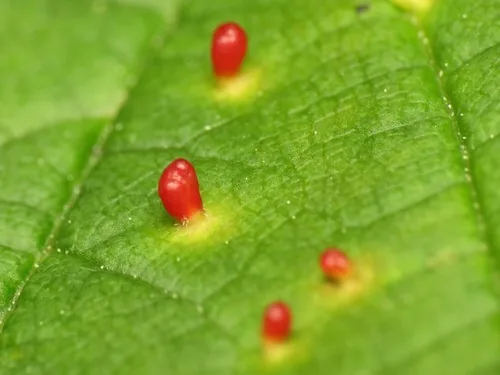
Field Identification
If leaves look dusty, speckled, bronzed, or curled without obvious chewing, rust mite is a likely suspect. Mites are tiny but can multiply fast, especially during heat and dry air. Plants lose vigor as feeding drains cell contents from leaves and tender growth. Early action matters, because heavy infestations can spread through a bed in days.
Use a hand lens and check leaf undersides first, especially near veins and new growth. Look for pinprick stippling, fine webbing in some species, and tiny moving dots that range from pale to red or brown. Tap a leaf over white paper; moving specks suggest active mites. Stippled leaves plus mites or eggs clustered under foliage confirms the diagnosis.
Not sure what you have? Use the symptom diagnosis tool →
How to Deal With It
Organic Control Methods
Typhlodromus pyri and other predatory mites in the Phytoseiidae family are the most important natural enemies of rust mites on grapes and tree fruit. These are already present in most orchards and vineyards with minimal pesticide use. Avoid broad-spectrum miticides and pyrethroids that collapse predatory mite populations -- rust mites rebound faster than predatory mites after chemical disturbance. Sulfur fungicide also kills predatory mites -- time sulfur applications carefully and avoid using it during periods of active predatory mite activity.
Rust mites cause russeting (bronze or silver discoloration) on fruit skin and leaves -- primarily a cosmetic issue on fruit but heavy infestations weaken plants. They are microscopic and not visible without a hand lens -- the damage is often the first visible sign. Scout early spring on susceptible cultivars. Populations build fastest in hot dry weather -- drought-stressed plants are most susceptible. Track which years and locations had bronzing after bloom to build a management calendar.
Maintain consistent irrigation -- drought stress increases rust mite reproduction and reduces plant tolerance. Prune for open canopy to improve spray coverage and air circulation. Reduce dust in orchards and vineyards by mowing or mulching pathways -- dust suppresses predatory mite populations. Avoid excessive nitrogen which prolongs the tender new growth that supports mite population surges.
Power washing foliage on small trees provides temporary knockdown but is rarely sufficient as a standalone control. Focus mechanical effort on dormant oil applications in late winter -- dormant oil smothers overwintering eggs and mites on bark and bud scales before populations establish in spring.
Sulfur fungicide controls rust mites effectively but also kills predatory mites -- use at minimum effective rates and time applications to avoid peak predatory mite activity. Horticultural oil during dormant season smothers overwintering stages before spring population buildup. Never mix oil and sulfur -- the combination causes severe phytotoxicity. Insecticidal soap for light infestations on small plants. Lime sulfur at delayed dormant timing is effective on deciduous fruit trees.
Let Nature Handle It
Natural Enemies
- Typhlodromus pyri
- Amblyseius spp.
- Minute Pirate Bugs
Threat Map