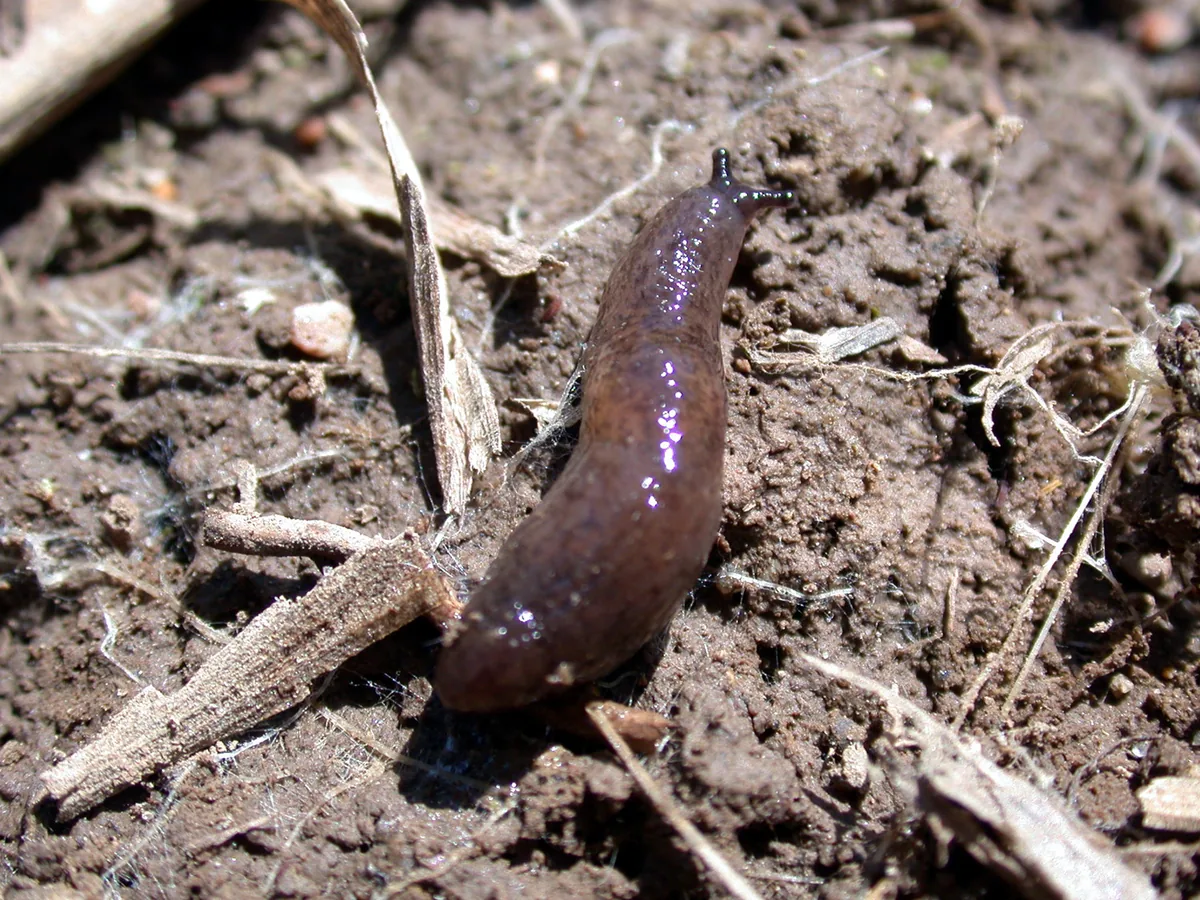
Field Identification
If seedlings disappear overnight, leaves have ragged irregular holes with no insect in sight, and there is a silvery slime trail on soil or leaves in the morning — slugs were there. They feed at night and hide during the day under debris, boards, dense mulch, and soil cracks. Slugs are essentially snails without shells, which means they dry out faster and are more dependent on moisture and cover. A wet spring or summer night followed by missing seedlings is the classic scenario. They can completely destroy a seedling in one night and will return to the same plants repeatedly until stopped.
Look for silvery dried slime trails on soil, pots, and lower leaves — this is the most reliable sign. Holes in leaves are ragged and irregular, not the clean cuts of caterpillars or the skeletonizing of beetles. Check under boards, dense mulch, low-lying leaves, and pot rims during the day — slugs cluster in cool damp hiding spots. Go out with a flashlight an hour after dark and you will find them actively feeding. Eggs are small, round, pearl-like clusters laid in soil under debris. Young slugs are translucent and tiny — easy to miss until populations build.
Not sure what you have? Use the symptom diagnosis tool →
How to Deal With It
Organic Control Methods
If you have a slug problem, the real answer is you have a duck problem — ducks are the most effective slug control available and will clear a garden of slugs faster than any other method. Khaki Campbell and Indian Runner ducks are particularly efficient. Ground beetles are the most important insect predator of slugs and their eggs — permanent mulch paths and undisturbed soil edges support ground beetle populations year-round. Frogs and toads eat slugs actively — a garden pond or water feature attracts them permanently. Hedgehogs where present are voracious slug predators. Nematodes (Phasmarhabditis hermaphrodita) specifically parasitize slugs and are available commercially — apply to moist soil when temperatures are above 40F (5C) for 2-3 week suppression.
Slugs need moisture and cover — remove both and populations collapse. Water in the morning so soil surface dries before evening when slugs feed. Remove boards, debris, and dense low ground cover near vulnerable plants. Slugs hide under anything on the ground — a piece of cardboard left overnight becomes a slug trap you can collect and destroy in the morning. Seedlings are highest risk — larger established plants tolerate slug feeding much better. Start seeds indoors and transplant larger starts rather than direct seeding into slug-prone beds. Copper reacts with slug mucus and causes a mild electric-like deterrent — copper tape around pots and raised bed edges works for container plants.
Rough, dry mulches like straw and wood chips are less hospitable than fine wet mulches. A dry soil surface strip around the perimeter of beds creates a barrier slugs are reluctant to cross. Avoid evening irrigation which creates ideal slug feeding conditions. Hand-pick at night with a flashlight — drop into soapy water or salt. Set out boards or wet cardboard as traps during the day and collect slugs underneath each morning. Beer traps (shallow containers sunk to soil level filled with cheap beer) attract and drown slugs effectively — empty and refill every 2-3 days. Garlic and chives planted at bed edges have some deterrent effect on slugs specifically.
Hand-picking at night is the fastest population reduction method — go out an hour after dark with a flashlight and salt shaker or bucket of soapy water. A single night of picking can dramatically reduce pressure. Copper tape barriers around individual pots and raised beds work well for container gardens. Coarse materials slugs dislike crossing — sharp sand, crushed eggshells, diatomaceous earth — applied as a dry band around vulnerable plants create physical barriers that must be reapplied after rain. Beer traps are highly effective: slugs are attracted from several feet away, fall in, and drown.
Diatomaceous earth (food grade) applied as a dry band around plants damages slug bodies through microscopic sharp edges — must be reapplied after every rain or irrigation as it loses effectiveness when wet. Iron phosphate baits (Sluggo, Escar-Go) are the safest and most effective organic slug bait — iron phosphate breaks down into iron and phosphate fertilizer, is safe around pets and wildlife, and slugs die underground after consuming it. Scatter lightly around plants rather than piling. Avoid metaldehyde baits which are toxic to pets, wildlife, and beneficial invertebrates. Salt kills slugs on contact but damages soil — use sparingly and not near plant roots.
Let Nature Handle It
Natural Enemies
- Ducks
- Ground Beetles
- Frogs
- Toads
- Hedgehogs
- Nematodes
Threat Map