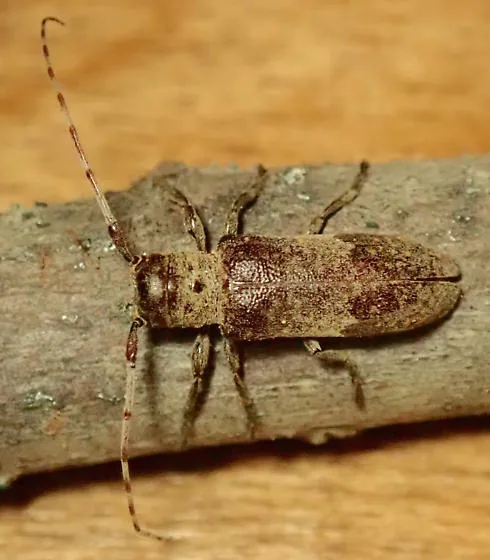
Field Identification
If new growth is curling, yellowing, sticky, or chewed, twig girdlers may already be on the plant. This pest often builds quietly, then damage appears all at once. Feeding stress weakens growth, reduces yield, and opens the door to secondary disease. Early cleanup is much easier than fighting a full population surge later.
Inspect the newest growth first: leaf undersides, flower buds, stem joints, and tender tips where pests gather. Look for body shape, color, eggs, cast skins, honeydew, webbing, or fresh puncture marks. A hand lens and a white paper tap test help reveal small life stages. Matching visible pests with fresh plant damage confirms active infestation.
Not sure what you have? Use the symptom diagnosis tool →
How to Deal With It
Organic Control Methods
Woodpeckers and other bark-foraging birds hunt twig girdler larvae in cut branches on the ground -- leaving cut branches accessible rather than immediately removing them allows birds to find and eat the larvae inside. Parasitic wasps attack larvae in galleries. Diverse habitat supporting insectivorous birds near orchards and woodlands provides continuous predation pressure on twig girdler populations. Healthy trees with vigorous growth are more tolerant of girdling damage than stressed trees.
Twig girdlers are long-horned beetles that cut neat circles around pencil-thick branches in late summer and fall -- the cut branch hangs or falls cleanly, looking like a pruning cut. The female lays eggs in the cut end of the fallen branch and larvae develop in the wood over winter. Finding and destroying fallen girdled branches before larvae complete development breaks the cycle. Scout under trees in August through October for fallen twigs with characteristic clean cuts. Stressed trees attract more girdling beetles -- maintain tree vigor with proper irrigation and soil health.
Collect and destroy all fallen girdled branches immediately -- larvae inside complete development in the cut wood and emerge as adults the following summer. Do not chip girdled wood for mulch as larvae inside survive. Bag or burn fallen branches. Avoid excessive nitrogen fertilization which produces soft wood that is easier to girdle. Maintain tree vigor with consistent irrigation during drought since stressed trees attract more adult beetles.
Collect all fallen girdled twigs and branches during August through October when adults are active -- this is the single most impactful management action. Prune out any hanging girdled branches that have not yet fallen to prevent larvae from completing development. Check under trees weekly during girdling season. Sticky trunk bands catch some adult beetles but are not reliable as a primary control.
Kaolin clay applied to trunk bark and major limb surfaces during adult activity (August through October) deters female beetles from laying eggs in girdled branches. Neem oil on bark surfaces disrupts adult feeding and egg-laying behavior. Pyrethrin provides quick knockdown of adults during peak emergence but degrades in hours -- apply at dusk as a last resort for high-value trees with severe annual pressure. No spray is as effective as collecting and destroying fallen girdled branches.
Let Nature Handle It
Natural Enemies
- Birds
- Parasitic Wasps
- Predatory Beetles
Threat Map