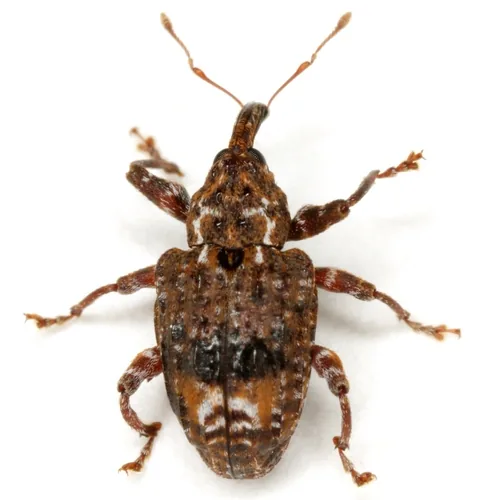
Field Identification
If new growth is curling, yellowing, sticky, or chewed, plum curculio may already be on the plant. This pest often builds quietly, then damage appears all at once. Feeding stress weakens growth, reduces yield, and opens the door to secondary disease. Early cleanup is much easier than fighting a full population surge later.
Inspect the newest growth first: leaf undersides, flower buds, stem joints, and tender tips where pests gather. Look for body shape, color, eggs, cast skins, honeydew, webbing, or fresh puncture marks. A hand lens and a white paper tap test help reveal small life stages. Matching visible pests with fresh plant damage confirms active infestation.
Not sure what you have? Use the symptom diagnosis tool →
How to Deal With It
Organic Control Methods
Ground beetles, birds, and toads consume plum curculio adults and larvae on the orchard floor — encourage them with permanent diverse groundcover between trees. Chickens allowed supervised access under trees can pick larvae from fallen fruit effectively where food safety permits. Steinernema carpocapsae nematodes applied to soil under trees target larvae that drop to pupate — apply when soil is moist and above 60F (15C). The most important biological strategy is maintaining habitat for ground-dwelling predators that work the orchard floor continuously.
Plum curculio adults migrate from woodland edges into orchards at petal fall and make distinctive crescent-shaped egg-laying cuts in young fruit. Finding these cuts on fruit within the first 2-3 weeks after petal fall is the diagnostic sign. Management must begin immediately at petal fall before adults establish — delayed action allows egg-laying that cannot be reversed. Remove and destroy all dropped fruit every 2-3 days during curculio season — this starves larvae and dramatically reduces next year adult population.
Daily or every-other-day collection and destruction of dropped fruit is the single most important cultural practice — more impactful than any spray. Mow or mulch under trees to expose fallen fruit and larvae to predators. Prune for open canopy to improve spray coverage. Woodland edges adjacent to orchards are the source of migrating adults — a buffer of mowed grass between woods and orchard slows invasion.
Shake adult curculios from dwarf trees onto ground cloths in cool mornings when adults are sluggish — collect and destroy. Feasible for small plantings and surprisingly effective. Kaolin clay particle film on fruit deters feeding and egg-laying — apply before migration at petal fall and maintain after rain. Individual fruit bagging excludes curculio completely for small high-value plantings.
Kaolin clay (Surround) is the most effective organic spray for plum curculio — begin applications at petal fall before adults arrive and reapply every 7-10 days and after rain, coating all fruit surfaces and stems thoroughly. Spinosad provides knockdown of adults during peak migration — apply at dusk to minimize bee exposure. Pyrethrin provides quick knockdown but degrades in hours — last resort only at dusk. No spray substitutes for daily dropped fruit removal.
Let Nature Handle It
Natural Enemies
- Insectivorous Birds
- Ground Beetles (Carabidae)
- Toads and Frogs (Anura)
- Ants (Formicidae)
Threat Map