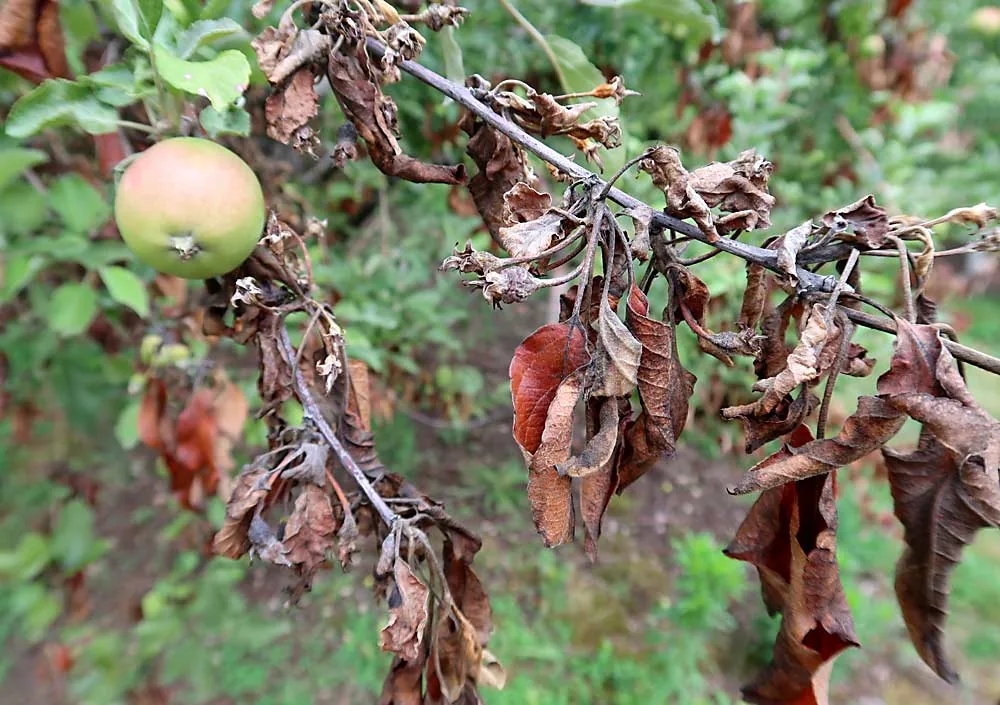
Field Identification
If leaves, stems, or fruit suddenly look spotted, sunken, or rotting, fire blight may already be active. This problem often starts small, then spreads across healthy tissue before most growers realize how serious it is. Warmth, moisture, and crowded foliage usually speed it up. Treat early, because waiting even a few days can turn a manageable infection into major crop loss.
Look for a pattern, not one bad leaf: expanding spots, dark or pale halos, fuzzy growth, or tissue that collapses when touched. Check both leaf surfaces, stem bases, and fruit scars where symptoms first appear. New lesions after rain, overhead watering, or heavy dew are a strong clue. When separate spots begin merging into larger dead patches, the disease is advancing quickly.
Not sure what you have? Use the symptom diagnosis tool →
How to Deal With It
Organic Control Methods
Bacillus subtilis (Serenade) and B. amyloliquefaciens colonize flower surfaces and suppress Erwinia amylovora during the critical bloom infection window — apply at every bloom spray timing. Pseudomonas fluorescens (BlightBan) competes directly with fire blight bacteria at blossom surfaces and is one of the most effective biological controls for any bacterial plant disease. These must be applied preventively before infection — once fire blight is in the tree no biological or chemical treatment stops it. Diverse soil biology and mycorrhizal fungi support tree health and immune response to fire blight infection.
Fire blight spreads through open blossoms during warm wet weather above 60F (15C) — the bacteria enter through flowers and are then spread by bees, rain, and insects. Once inside the tree it moves through vascular tissue and cannot be stopped. The entire strategy must focus on bloom protection. Copper spray at half-inch green through pink bud reduces bacteria on bark surfaces. Forecasting models (Maryblyt, Cougarblight) predict high-risk infection periods using temperature and wetness data — more accurate than calendar timing.
Prune infected shoots 8-12 inches below the lowest visible symptom during dry weather — the bacteria extend further into wood than symptoms show. Sterilize pruning tools between every cut with 70% isopropyl alcohol or 10% bleach — fire blight spreads on contaminated tools as fast as on bees. Remove all infected material from the orchard immediately and destroy. Avoid excess nitrogen fertilization which produces the succulent shoot growth most susceptible to fire blight infection. Plant resistant varieties — modern apple and pear breeding has produced many excellent fire blight resistant cultivars.
Pruning infected tissue is the only mechanical control — cut 8-12 inches below visible symptoms and sterilize tools between every cut without exception. Remove all prunings from the orchard and bus — the wilted shepherd's crook shape of blighted shoots is unmistakable. Early removal of new infections prevents spread to larger scaffold branches and the main trunk where fire blight becomes fatal.
Copper applied at half-inch green through pink bud reduces overwintering inoculum on bark. Bloom-time applications of Bacillus subtilis, B. amyloliquefaciens, or kaolin clay at every blossom spray timing are the primary organic bloom protection strategy. Apply every 3-5 days during bloom when temperatures and wetness favor infection. Copper during bloom can reduce fruit russeting — use lower rates and buffer with lime if needed. No spray cures fire blight already inside the tree.
Let Nature Handle It
Natural Enemies
- Beneficial Microbes
- Antagonistic Bacteria
Threat Map