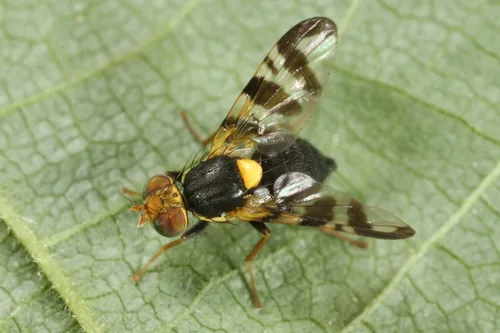
Field Identification
If leaves show trails, fruit turns soft, or roots collapse from inside, cherry fruit fly may already be feeding. The larval stage does most of the damage, often hidden where you cannot see it at first glance. By the time yellowing or rot appears, feeding may be well underway. Move quickly when symptoms begin to prevent another wave of eggs and larvae.
Watch for tiny eggs near plant tissue, pale legless larvae inside mines or fruit, and sudden soft spots or tunnels. Adults are usually small flies that hover or dart when disturbed. Check around wounds, blossoms, and moist plant debris where egg-laying is common. Cut open suspect tissue: live maggots or fresh tunnels are the clearest field confirmation.
Not sure what you have? Use the symptom diagnosis tool →
How to Deal With It
Organic Control Methods
Ground beetles, birds, and ants consume cherry fruit fly larvae and pupae in soil under trees — maintain permanent diverse groundcover to support these predators year-round. Parasitic wasps provide weak control compared to sanitation but contribute to overall population pressure. Chickens or ducks allowed supervised orchard access consume larvae in fallen fruit where food safety regulations permit. Steinernema feltiae nematodes applied to soil under tree drip lines target pupating larvae.
Cherry fruit fly adults emerge in late spring and lay single eggs under the skin of developing cherries — the entry hole is invisible and larvae are found only when fruit is cut. Red sticky sphere traps baited with ammonium acetate and cherry volatile monitor adult emergence — first catch indicates egg-laying has begun and protection must be in place. Harvest promptly when fruit reaches maturity — overripe cherries are far more attractive to laying females and larvae develop faster in warm fruit.
Collect and destroy all fallen and infested fruit every 2-3 days during ripening season — this breaks the cycle more reliably than any spray. Mow or mulch dropped fruit to prevent larvae from reaching soil to pupate. Prune for open canopy to improve spray coverage and expose fruit to bird predation. Fine netting over entire dwarf trees after pollination is complete is the most reliableor small plantings.
Fine mesh netting over entire dwarf trees after pollination excludes adult flies from laying eggs if edges are buried or secured. Red sticky sphere traps plus ammonium bait at 1 per tree both monitor populations and provide mass trapping at small scale. Individual fruit removal and disposal at first sign of infestation. Solarize shallow soil under trees in summer to kill pupae.
Spinosad applied to foliage starting at first adult catch and reapplied every 7 days through harvest kills adults feeding on leaves before they can lay eggs — the most effective organic spray timing. Kaolin clay on fruit surfaces deters females from landing to lay eggs — apply every 7-10 days starting before adults emerge, more frequently after rain. Neem oil in rotation with kaolin provides additional deterrence. No spray reaches larvae already inside fruit — all treatments must be applied before egg-laying begins.
Let Nature Handle It
Natural Enemies
- Parasitic Wasps (Braconidae)
- Ground Beetles (Carabidae)
- Insectivorous Birds
- Ants (Formicidae)
Threat Map