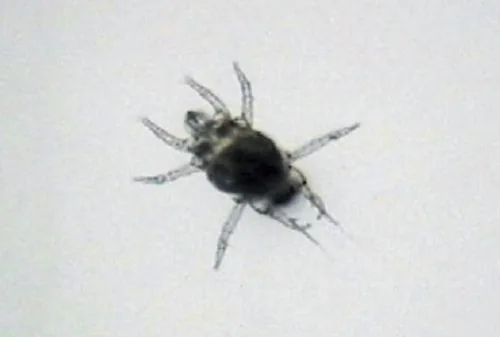
Field Identification
If leaves look dusty, speckled, bronzed, or curled without obvious chewing, broad mite is a likely suspect. Mites are tiny but can multiply fast, especially during heat and dry air. Plants lose vigor as feeding drains cell contents from leaves and tender growth. Early action matters, because heavy infestations can spread through a bed in days.
Use a hand lens and check leaf undersides first, especially near veins and new growth. Look for pinprick stippling, fine webbing in some species, and tiny moving dots that range from pale to red or brown. Tap a leaf over white paper; moving specks suggest active mites. Stippled leaves plus mites or eggs clustered under foliage confirms the diagnosis.
Not sure what you have? Use the symptom diagnosis tool →
How to Deal With It
Organic Control Methods
Neoseiulus cucumeris and Amblyseius swirskii predatory mites are used commercially in protected crops for broad mite control -- introduce preventively before damage peaks and maintain humidity above 65% for establishment. These are available from insectaries. For outdoor gardens, conserve generalist predators by avoiding unnecessary sprays. Broad mites are so small they are nearly invisible -- 1/100 inch -- which limits predator effectiveness since few predators can locate and eat them at that scale.
Broad mite damage looks like herbicide injury or virus -- new growth is distorted, thickened, bronze-colored, and twisted downward. Leaves may be hard and brittle. There is no webbing. By the time symptoms are obvious the infestation is well established. Broad mites spread primarily on infested transplants and on insect vectors like thrips and whitefly. Quarantine all new plant batches for 2 weeks before mixing with established plants. Sticky tape on boots between greenhouse houses reduces transfer. Scout growing points with a strong hand lens weekly.
Remove and destroy first symptomatic shoot tips immediately -- broad mites concentrate in actively growing tissue and removing infested tips reduces population and spread. Avoid moving infested transplants between growing areas. Lower humidity extremes that favor broad mite reproduction in greenhouses. Sanitize tools between plants. Broad mites cannot survive more than a few days without a plant host -- empty greenhouse sections and allow a 3-5 day fallow period before replanting to break the cycle.
Exclusion in greenhouses is the only reliable mechanical approach -- fine mesh on vents prevents adult mite entry and reduces thrips and whitefly that spread mites between plants. Remove infested growing tips to reduce population density and slow spread to adjacent plants. No field-scale mechanical control is practical for broad mites.
Sulfur applied early at first distortion symptoms suppresses broad mite populations -- apply every 5-7 days covering growing points and new tissue thoroughly where mites concentrate. Horticultural oil smothers mites but must contact them directly. Insecticidal soap on accessible tissue. Repeat applications every 3-5 days are essential -- broad mite eggs are laid deep in plant tissue and hatch continuously, meaning a single spray only addresses current adults and nymphs. Apply at dusk to protect beneficial insects.
Let Nature Handle It
Natural Enemies
- Neoseiulus cucumeris
- Amblyseius swirskii
- Minute Pirate Bugs
Threat Map