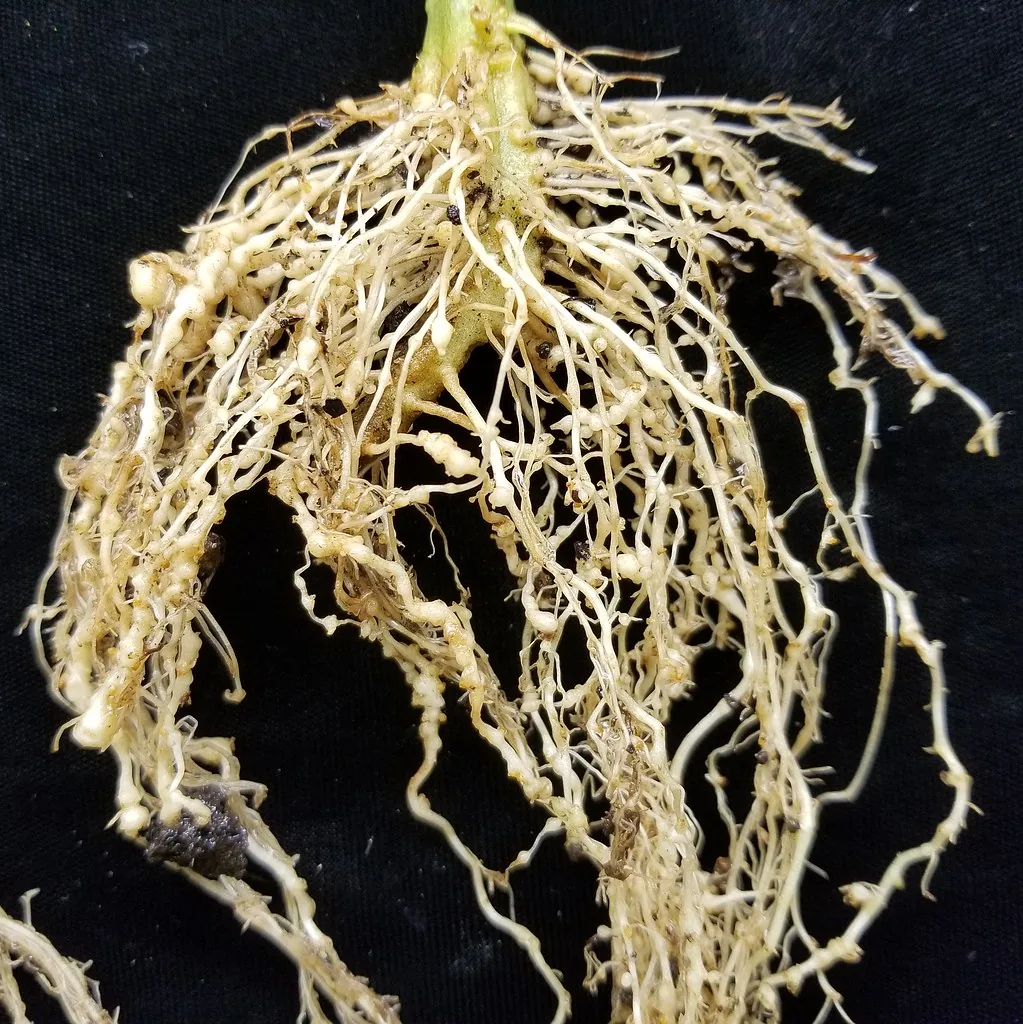
Field Identification
If plants stay stunted, yellow, and thirsty even with good care, rootknot nematodes may be attacking below ground. These microscopic pests damage roots, so the top growth declines before the cause is obvious. Yield drops and wilting worsen in heat because damaged roots cannot keep up. Once populations build in soil, control gets harder, so early detection is critical.
Gently lift a struggling plant and inspect roots for knots, lesions, branching distortion, or weak root mass. Affected plants often appear in patches rather than uniformly across the bed. Symptoms can mimic nutrient stress, but damaged roots with poor feeder growth are a key clue. Lab or microscope confirmation is best, but root injury patterns strongly indicate nematode pressure.
Not sure what you have? Use the symptom diagnosis tool →
How to Deal With It
Organic Control Methods
Pasteuria penetrans is a bacterial parasite that specifically attacks root-knot nematodes -- it occurs naturally in many soils and increases over time when nematode populations are high. Trichoderma and Bacillus subtilis as soil amendments improve overall root health and competitive exclusion. Beneficial nematodes (Steinernema feltiae) do not directly attack root-knot nematodes but improve overall soil biology. The most important biological investment is building diverse active soil biology -- soils with high organic matter and diverse microbial communities suppress root-knot nematodes significantly better than depleted soils. Mycorrhizal inoculants help roots tolerate nematode feeding.
Root-knot nematodes cause distinctive galls (knots) on roots -- dig up a struggling plant and check the roots. Healthy roots are smooth and white. Nematode-infested roots have round marble-like swellings along them. Plants above ground look drought-stressed despite adequate water because the damaged roots cannot absorb moisture effectively. Sandy soils are worst -- nematodes move freely through sand. Use certified nematode-free transplants. Never move soil from infested areas to clean beds. Nematode populations build rapidly on susceptible crops planted in the same spot year after year.
Crop rotation with non-host crops for 2-3 seasons is the most effective long-term management -- corn, onions, garlic, and small grains do not support root-knot nematode reproduction. French marigolds (Tagetes patula) planted densely and turned into the soil as a green manure produce compounds that kill root-knot nematodes -- one of the most effective organic nematode suppressants available. Incorporate large amounts of organic matter -- compost, cover crops, and mulch build the diverse soil biology that suppresses nematodes. Remove and destroy infected plant roots immediately.
Soil solarization (clear plastic over moist soil for 6-8 weeks in summer) kills root-knot nematodes in the top 6-8 inches where most feeding occurs -- highly effective in Florida and other hot climates with strong summer sun. Raised beds with fresh sterilized growing media provide a nematode-free start. Physical barriers of landscape fabric under raised beds prevent nematode migration from surrounding soil into clean beds.
Neem cake (the pressed residue after neem oil extraction) incorporated into soil releases compounds toxic to nematodes -- apply at 200-400 lbs per acre or equivalent for garden beds. Liquid neem oil as a soil drench has some nematicidal activity. Mustard seed meal incorporated into soil releases isothiocyanates that kill nematodes -- biofumigation. Chitosan soil drench stimulates plant immune response and reduces nematode reproduction. French marigold extract as a soil drench shows consistent results in research trials.
Let Nature Handle It
Natural Enemies
- Beneficial Nematodes
- Soil Microbes
- Predatory Fungi
Threat Map