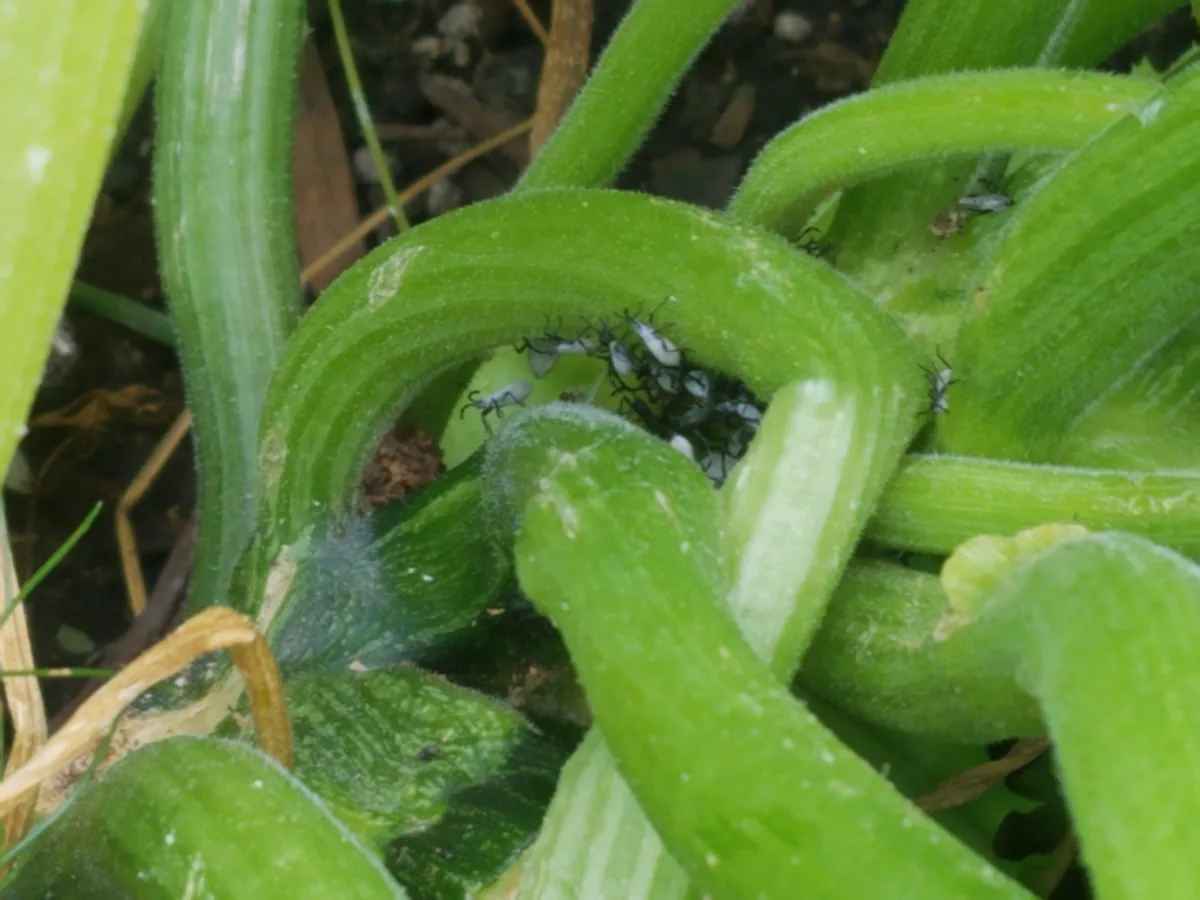
Field Identification
If new growth is curling, yellowing, sticky, or chewed, squash bug may already be on the plant. This pest often builds quietly, then damage appears all at once. Feeding stress weakens growth, reduces yield, and opens the door to secondary disease. Early cleanup is much easier than fighting a full population surge later.
Inspect the newest growth first: leaf undersides, flower buds, stem joints, and tender tips where pests gather. Look for body shape, color, eggs, cast skins, honeydew, webbing, or fresh puncture marks. A hand lens and a white paper tap test help reveal small life stages. Matching visible pests with fresh plant damage confirms active infestation.
Not sure what you have? Use the symptom diagnosis tool →
How to Deal With It
Organic Control Methods
Tachinid flies (Trichopoda pennipes) parasitize squash bug adults — they lay eggs on the bug's thorax and larvae develop inside, killing it. To attract tachinid flies, plant flowering herbs like dill, fennel, cilantro, and sweet clover at bed edges. These flies are already present in most gardens; the goal is habitat, not purchase. Ground beetles and spiders prey on eggs and nymphs — deep mulch and permanent ground cover nearby supports these predators year-round. Squash bugs have relatively few natural enemies compared to softer-bodied pests, so mechanical control is more reliable than waiting for biology to catch up.
Squash bugs overwinter as adults in garden debris and emerge in late spring to lay eggs. Destroy all cucurbit crop residue immediately after harvest — do not compost it. Till or rake beds in early spring to expose overwintering adults. Scout cotyledons and first true leaves twice weekly from transplant onward — egg masses appear early on leaf undersides near veins, copper-bronze and arranged in neat rows. Finding and crushing eggs is 10 seconds of work that prevents weeks of damage. Squash bugs are hardest to kill as adults — every egg you crush is an adult you never have to fight.
Resistant varieties exist — Butternut squash is significantly less preferred than most summer squash. Hubbard squash is highly attractive and can be used as a trap crop at bed edges where squash bugs concentrate and can be destroyed. Row covers from transplant until female flowers open prevents adult colonization during the most vulnerable period. Remove covers at bloom for pollination. Plant nasturtiums and tansy at bed edges — both have some repellent effect on squash bugs specifically.
Crush egg masses on every scouting pass — this is the highest-value activity for squash bug management. Eggs are bronze, oval, and laid in precise rows on leaf undersides, usually near main veins. Boards or wet cardboard placed near vines overnight trap hiding adults — check and destroy them in the morning before they disperse into heat. Nymphs in early instars are soft and vulnerable; hand-crush or drop into soapy water. Adults have a hard cuticle that most sprays bounce off — mechanical removal is more reliable than spraying mature bugs.
Insecticidal soap and neem work on nymphs in early instars (first 2-3 weeks after hatch) before their cuticle hardens — spray directly on clusters on leaf undersides, every 3-5 days while egg batches are still hatching. Once nymphs mature into adults, sprays lose effectiveness rapidly. Kaolin clay applied to leaf surfaces deters egg-laying and feeding — coat new growth every 7 days and after rain. Pyrethrin provides quick knockdown on adults but degrades in hours and harms beneficials — use only at dusk as a last resort for overwhelming infestations, never near flowers.
Let Nature Handle It
Natural Enemies
- Trichopoda pennipes
- Minute Pirate Bugs (Orius spp.)
- Ground Beetles (Carabidae)
- Orb-weaver Spiders
Threat Map