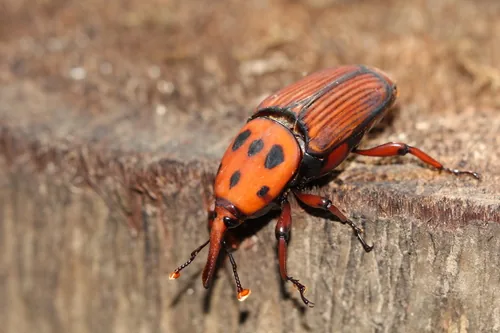
Field Identification
If plants are wilting, notching at the edges, or fruit and roots show hidden feeding damage, red palm weevil may be the cause. Adults chew above ground while larvae often feed out of sight inside soil, stems, or fruit. Damage builds quietly, then plants crash fast when roots are heavily hit. Act early so a small weevil problem does not become a season-long infestation.
Look for small beetles with a hard body and a distinct snout, usually active at dawn, dusk, or night. Check for crescent-shaped leaf notches, punctures in fruit, or tiny entry holes near stems. In soil or damaged tissue, larvae are often pale, legless, and curved in a C-shape. Fresh chew marks plus snout beetles or C-shaped grubs confirm active weevil pressure.
Not sure what you have? Use the symptom diagnosis tool →
How to Deal With It
Organic Control Methods
Classical programs overseas release egg parasitoids that attack weevil eggs on crown tissue -- those insects are regulated and not a backyard mail-order. Woodpeckers and large ants sometimes pull larvae from soft crowns when damage is still shallow. Beauveria bassiana and Metarhizium fungi infect adults and larvae if spores stay wet long enough to penetrate the insect cuticle -- they are tools, not spells. Ants and woodpeckers will not save a palm whose heart is already tunneled; they help at the margins when sanitation happens on time.
Adults fly to wounded palms and fresh cut surfaces -- inspect every new palm at planting and reject stock with oozing holes or odd sawdust at the crown. Report suspect palms to agricultural authorities where programs exist; early detection protects whole neighborhoods. Do not move chipped palm debris off-site without treatment rules; grubs ride in hidden fibers. Pheromone traps for monitoring tell you when males are active so you double-check nearby sanitation. Zero tolerance for "we will deal with that stump later" after pruning.
Remove and destroy severely infested palms before adults emerge -- chip on site under supervision if regulations require. Avoid leaving tall stumps as brood hotels; grind stumps below grade when possible. Quarantine nursery blocks from regions with established populations until inspectors clear material. When pruning, sterilize tools between trees and never spike a declining palm for temporary support; fresh wounds scream egg-laying site. Coordinate community removal so one untreated yard does not reinfect the block.
Pheromone-baited bucket traps capture male weevils and reduce mating when used as networks, not single buckets near patios. Acoustic tools listen for larval chewing in the crown before fronds collapse -- training matters, false positives happen. For short palms, probe soft spots with a thin wire to destroy accessible larvae when laws allow. Fine mesh sleeves around valuable young palms exclude adults during flight peaks if frames do not wound trunks.
Beauveria bassiana and Metarhizium formulations labeled for palm borers go into crown axils as drenches or high-volume sprays during adult activity -- coverage deep in the crown beats brand loyalty. Repeat on schedules the label allows; fungi need moisture to infect. Chitosan and other biofilm disruptors show promise in trials; pair any spray with removal of infested tissue. Neem or soap do not fix advanced tunneling. Always follow worker safety rules for aerial lifts and ladder work near collapsing crowns.
Let Nature Handle It
Natural Enemies
- Scelionid egg parasitoids
- Beauveria bassiana
- Metarhizium spp.
Threat Map