About
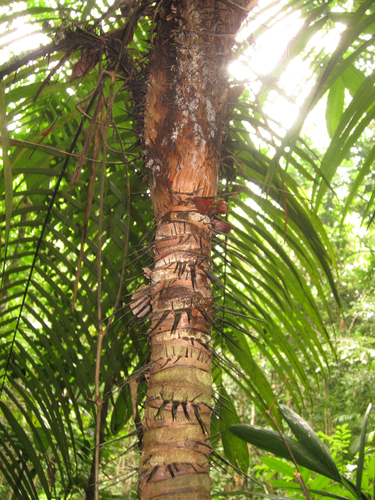
Tucumã (Astrocaryum vulgare) is a solitary, heavily armed palm of Amazonian forests and secondary growth, with long spines on petioles and trunk and orange, oily mesocarp around a hard endocarp. It reaches forest stature over many years; juvenile plants are rosettes of viciously spiny leaves before a trunk lifts the crown. The species is valued regionally for pulp, oil, and craft fiber from leaf bases and spines. In Puerto Rico and tropical and subtropical zones it is a niche palm for collectors in frost-free sites; spines and cold sensitivity make it unsuitable for high-traffic yards. Humid heat matches its ecology; drought slows growth but established palms tolerate seasonal dry periods with deep soil moisture. ☀️💧 Sun and Water Requirements: - Full sun once established in humid tropics; young palms benefit from high canopy or dappled shade to reduce leaf scorch during establishment. - Deep, fertile, well-drained soil with reliable moisture in the warm season; avoid chronic waterlogging around the root zone. - Plan access paths—every petiole is a lesson in respect. ✂️ Propagation: - Sow fresh seed in warm, humid conditions; germination is slow and sporadic as seed viability drops with age. - Transplant seedlings with care; spines begin early. 🌾 Harvest / Best Use Timing: - Harvest ripe fruit when color and local practice indicate peak oil and pulp quality; processing is labor-intensive and traditionally skilled. - Fiber harvest ties to pruning and craft schedules where traditional knowledge exists.
Permaculture Functions
- Edible: Mesocarp pulp and oil are regional foods where processing infrastructure or household skill exists.
- Fiber: Spines and leaf bases supply craft fiber for cordage and weaving in Amazonian traditions.
- Wildlife Attractor: Fruit feeds mammals and large birds in native range; fallen fruit in the yard will recruit local frugivores.
Tucumã belongs in serious tropical polycultures, not polite suburbia:
Practitioner Notes
- Morning picks hold turgor; afternoon heat steals shelf life even if the cooler feels honest.
- Sharp tools and clean cuts beat torn stems; disease spores love frayed tissue more than rhetoric.
- Harvest texture changes faster than color—nip one sample before you commit the whole row to a pick date.
- Notebook one weird year—weather anomalies repeat; memory lies, scribbles do not.
Companion Planting
- Cacao
- Banana
- Papaya
- High-traffic paths
- Pet and toddler zones
Pest Pressure