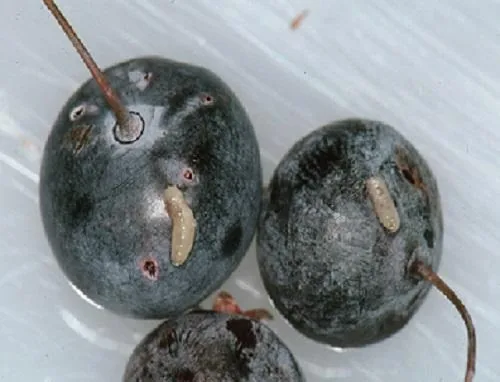
Field Identification
If leaves show trails, fruit turns soft, or roots collapse from inside, blueberry maggot may already be feeding. The larval stage does most of the damage, often hidden where you cannot see it at first glance. By the time yellowing or rot appears, feeding may be well underway. Move quickly when symptoms begin to prevent another wave of eggs and larvae.
Watch for tiny eggs near plant tissue, pale legless larvae inside mines or fruit, and sudden soft spots or tunnels. Adults are usually small flies that hover or dart when disturbed. Check around wounds, blossoms, and moist plant debris where egg-laying is common. Cut open suspect tissue: live maggots or fresh tunnels are the clearest field confirmation.
Not sure what you have? Use the symptom diagnosis tool →
How to Deal With It
Organic Control Methods
Parasitic wasps attack pupae in soil; ground beetles eat larvae in dropped berries; birds and chickens pick larvae from berries on the ground. These helpers help only if you leave some soil surface undisturbed and avoid nightly pyrethrin baths across the whole farm. Nematodes labeled for pupae sometimes work in light soils when soil temperature fits the product. Chickens under bushes after harvest are biocontrol with a business plan.
Rhagoletis mendax adults fly when berries soften -- yellow sticky spheres coated with ammonium bait mimic fruit and catch females for monitoring. Hang traps before first ripe berry; rising catches mean net covers or spray windows. Remove every fallen fruit daily during harvest; larvae complete in berries on the ground. Mow or rake under bushes so fruit does not hide in thatch. Wild blueberries along woods can be reservoirs; scout edges first.
You cannot rotate a blueberry bush, but you can remove alternate hosts such as honeysuckle berries near rows if they extend the fly season. Keep rows mulched so dropped fruit dries fast; wet thatch holds pupae. Prune for airflow so inner clusters dry after rain; flies still lay, but secondary rot stacks less. After harvest, clean pick promptly so late berries do not ferment on the bush.
Fine mesh netting over entire bushes after pollination stops females from reaching fruit -- seal edges to the ground. Sticky traps alone are monitoring tools; they rarely catch enough females to save a commercial crop. For small plots, individual fruit socks work on prized clusters. Rake and destroy ground fruit before pupation in late summer.
Spinosad and neem applied to foliage and fruit can deter egg-laying when timed to trap catches -- follow label PHI for fresh market. Insecticidal soap kills adults on contact if you spray calm evenings when flies rest on leaves. Kaolin clay on berries repels landing females when film stays even; rebuild after rain. Combine any spray with sanitation; sprays fail if rotten fruit still perfumes the row.
Let Nature Handle It
Natural Enemies
- Parasitic Wasps
- Predatory Beetles
- Insectivorous Birds
Threat Map