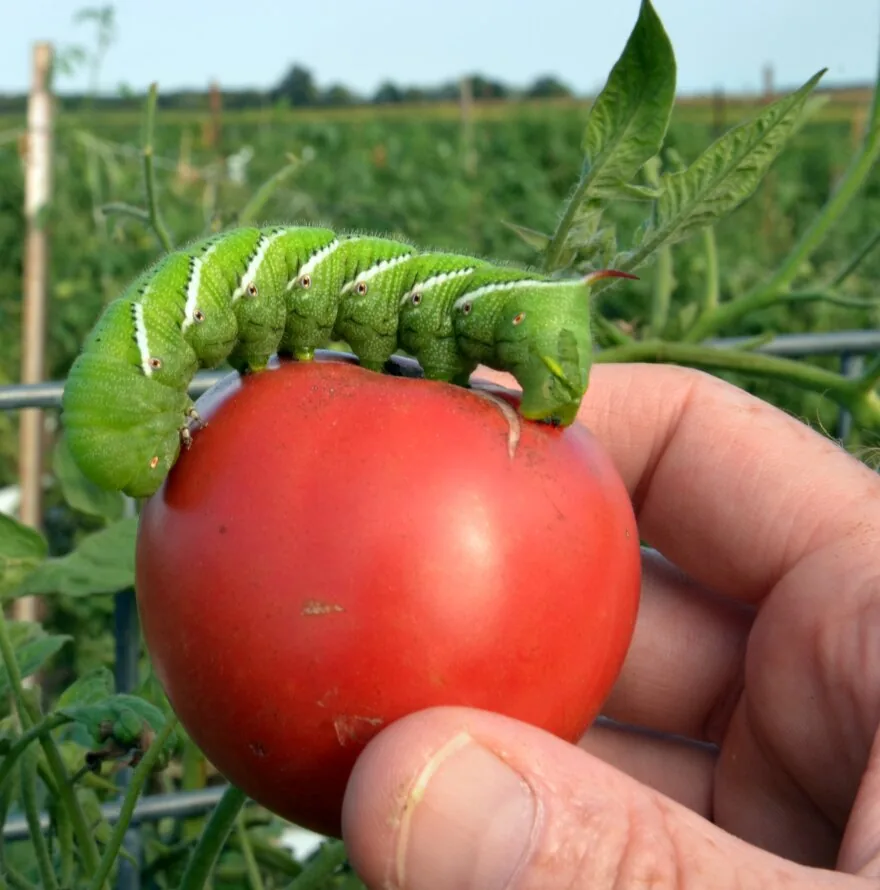
Field Identification
If leaves look shredded overnight or fruit has fresh chew holes, tomato hornworms may be feeding right now. These larvae can eat fast and strip a healthy plant in a short window. Young stages are easy to miss, then damage suddenly explodes as they grow. Catch them early to avoid severe defoliation and contaminated harvests.
Check leaf undersides, growing tips, and stem junctions for eggs, frass pellets, and feeding scars. Larvae vary in color, but most have a soft segmented body and blend into foliage. Look at dusk or early morning when many species feed more actively. Fresh chewing plus live larvae or droppings on lower leaves confirms an active caterpillar outbreak.
Not sure what you have? Use the symptom diagnosis tool →
How to Deal With It
Organic Control Methods
Braconid wasps (Cotesia congregata) are the hornworm's most effective natural enemy — if you see a hornworm covered in small white rice-shaped cocoons on its back, leave it alone. Those are parasitic wasp pupae. The hornworm is already dying and the emerging wasps will hunt more hornworms in your garden. Killing it destroys the next generation of your best allies. To attract braconid wasps, plant dill, fennel, and parsley nearby and let some bolt to flower. Birds — especially mockingbirds and catbirds — eat hornworms actively if you provide habitat.
The adult sphinx moth lays single eggs on leaf undersides in early summer — one moth produces dozens of eggs across multiple plants. Check weekly from early summer onward by looking for pale green spherical eggs on leaf undersides. One hornworm found early is a 5-second removal. One hornworm found after a week of feeding means stripping and searching a decimated plant. Tilling soil after harvest kills overwintering pupae — hornworms pupate underground through winter and emerge as moths the following summer.
Hornworms are specialists on Solanaceae — tomato, pepper, eggplant, potato. They do not spread to other plant families, so physical separation from susceptible crops limits damage spread. Interplanting with borage, marigolds, or dill at the base of tomatoes attracts parasitic wasps that target hornworm eggs and young larvae. Diverse plantings slow moth navigation and reduce egg-laying rates on any single plant. Remove crop residues at season end to eliminate egg-laying sites for late-season moths.
Hand-picking is the most effective control for small gardens — check plants at dusk or dawn when hornworms are most active. Use a UV blacklight at night: hornworms glow bright green under UV and are easy to spot even when perfectly camouflaged in daylight. Drop picked hornworms into soapy water. For larger plantings, look for the droppings first — dark green pellets on lower leaves mean a hornworm is feeding above. Follow the droppings up the stem to find it.
Bacillus thuringiensis (Bt) kurstaki is the most effective and specific spray for hornworms — it is a naturally occurring soil bacteria that kills caterpillars when ingested but is completely harmless to everything else. Spray in the evening when larvae are feeding, covering leaf surfaces thoroughly. It only works on larvae under 1 inch — larger hornworms have too much mass for a lethal dose. Apply every 5-7 days during peak season. Spinosad is effective on larger larvae when Bt timing is missed — apply at dusk to minimize impact on bees. Neither spray harms the braconid wasps that are your best long-term control.
Let Nature Handle It
Natural Enemies
- Parasitic Wasps
- Birds
- Predatory Insects
Threat Map